

TL;DR
Apache Kafka has become the backbone of modern event-driven architectures, enabling organizations to process, analyze, and act on real-time data at scale. As adoption has grown, managed Kafka services have become the preferred deployment model for many enterprises because they simplify cluster provisioning, upgrades, monitoring, and day-to-day operations.
However, enterprise requirements have evolved. While operational simplicity remains important, organizations now need greater control over where their data resides, how it is secured, and how cloud infrastructure is managed. Increasing regulatory requirements, growing cloud networking costs, and concerns around vendor lock-in are driving enterprises to rethink traditional vendor-hosted Kafka deployments.
This shift has accelerated the adoption of BYOC Kafka (Bring Your Own Cloud Kafka), a deployment model that combines the operational benefits of managed Kafka with the control and security of running infrastructure inside the customer's own cloud environment. Instead of moving streaming workloads into a vendor's cloud, organizations can keep their Kafka brokers, storage, networking, and data within their own AWS, Microsoft Azure, or Google Cloud account while continuing to benefit from managed platform operations.
Condense builds on this approach by providing BYOC Kafka as part of a unified, AI-assisted application platform for real-time data streaming. Beyond managing Kafka infrastructure, Condense enables engineering teams to build, deploy, operate, and autonomously scale production-grade streaming applications through a single platform, simplifying the complete lifecycle of data streaming applications while ensuring data remains within the organization's cloud environment.
If you're new to the BYOC deployment model, our guide on What Is Bring Your Own Cloud (BYOC) and Why Is It Important? explains the concept in detail and why it is becoming the preferred cloud strategy for enterprise platforms.
In this guide, you'll learn what BYOC Kafka is, how it differs from traditional vendor-hosted deployments, why enterprises are adopting it to address data sovereignty, compliance, and cloud networking costs, and how Condense combines BYOC Kafka with a unified platform for building and operating enterprise-grade data streaming applications.
Why Enterprises Are Rethinking Vendor-Hosted Kafka
Managed Kafka services have made it easier for organizations to adopt Apache Kafka without the operational burden of managing brokers, upgrades, and cluster maintenance. This convenience has helped accelerate the adoption of real-time data streaming across industries, enabling engineering teams to focus more on application development and less on infrastructure management.
As Kafka deployments mature, however, enterprises often discover that operational simplicity is only one part of the equation. Streaming platforms process some of an organization's most valuable data, including customer information, financial transactions, connected device telemetry, operational metrics, and business-critical events. Where this data is processed, stored, and transferred has become just as important as how Kafka is managed.
Many vendor-hosted Kafka services require organizations to move their streaming infrastructure into the provider's cloud environment. While this model reduces operational overhead, it can introduce new challenges around data sovereignty, regulatory compliance, cloud networking costs, infrastructure visibility, and vendor dependency. These challenges become more significant as data volumes increase and organizations expand across multiple regions and cloud environments.
Rather than choosing between operational simplicity and infrastructure control, enterprises are increasingly adopting deployment models that deliver both. This is one of the primary reasons BYOC Kafka has gained momentum across regulated industries and large-scale enterprise deployments.
Limited Infrastructure Control
With traditional vendor-hosted Kafka services, the underlying infrastructure is owned and managed by the provider. Organizations typically have limited visibility into how Kafka brokers are deployed, how networking is configured, or where data is physically processed. While this abstraction simplifies operations, it also reduces the level of control many enterprises require for governance, security, and cloud architecture.
For organizations with strict infrastructure standards or internal security policies, this lack of control can become a significant operational constraint.
Growing Data Sovereignty Concerns
Streaming platforms frequently process sensitive business and customer data that may be subject to regional regulations or internal governance policies. When Kafka runs inside a vendor-managed environment, organizations often have limited control over where data is stored, how it traverses networks, and which cloud resources are involved in processing it.
As governments continue to strengthen data protection regulations, enterprises are increasingly looking for deployment models that allow them to maintain complete ownership of their data while still benefiting from managed operations.
Rising Cloud Networking Costs
Network traffic is one of the most overlooked costs in large-scale Kafka deployments. Applications running inside a customer's cloud environment often need to exchange data continuously with Kafka clusters hosted elsewhere. As event volumes grow, cross-cloud and cross-region traffic can generate substantial network egress charges that are difficult to predict and optimize.
For many organizations, these costs become a major factor when evaluating long-term Kafka deployment strategies.
Vendor Lock-In
Vendor-hosted services can also make it more difficult to adapt infrastructure as business requirements evolve. Migrating data, integrating with existing cloud architectures, or adopting a multi-cloud strategy may require significant effort when the streaming platform is tightly coupled to a provider's environment.
BYOC Kafka addresses these challenges by allowing organizations to retain ownership of their infrastructure while continuing to benefit from managed platform operations, making it easier to maintain architectural flexibility without compromising operational efficiency.
What Is BYOC Kafka?
BYOC Kafka (Bring Your Own Cloud Kafka) is a deployment model that allows organizations to run Apache Kafka entirely within their own cloud environment while continuing to benefit from managed operations. Unlike traditional vendor-hosted Kafka services, where both the platform and infrastructure reside in the provider's cloud account, BYOC keeps the infrastructure under the customer's ownership.
This means Kafka brokers, storage, networking, and streaming data remain within the customer's AWS, Microsoft Azure, or Google Cloud environment. At the same time, the platform provider manages operational responsibilities such as provisioning, upgrades, monitoring, health checks, and lifecycle management.
The result is a deployment model that combines the operational simplicity of managed Kafka with the security, control, and flexibility of customer-owned cloud infrastructure.
If you're new to the BYOC deployment model, our guide on What Is Bring Your Own Cloud (BYOC) and Why Is It Important? explains the concept in detail and why it is becoming the preferred cloud strategy for enterprise platforms.
Understanding the Control Plane and Data Plane
The easiest way to understand BYOC Kafka is by separating the platform into two logical components: the control plane and the data plane.
The control plane manages the Kafka platform. It automates operational tasks such as cluster provisioning, software updates, scaling, monitoring, health management, and lifecycle operations. Since it contains management logic rather than customer data, it can be operated securely by the platform provider.
The data plane is where Kafka processes and stores streaming data. It includes Kafka brokers, topics, partitions, persistent storage, networking, and every event flowing through the platform. In a BYOC deployment, this entire data plane remains inside the customer's cloud account, ensuring that sensitive business data never leaves the organization's environment.
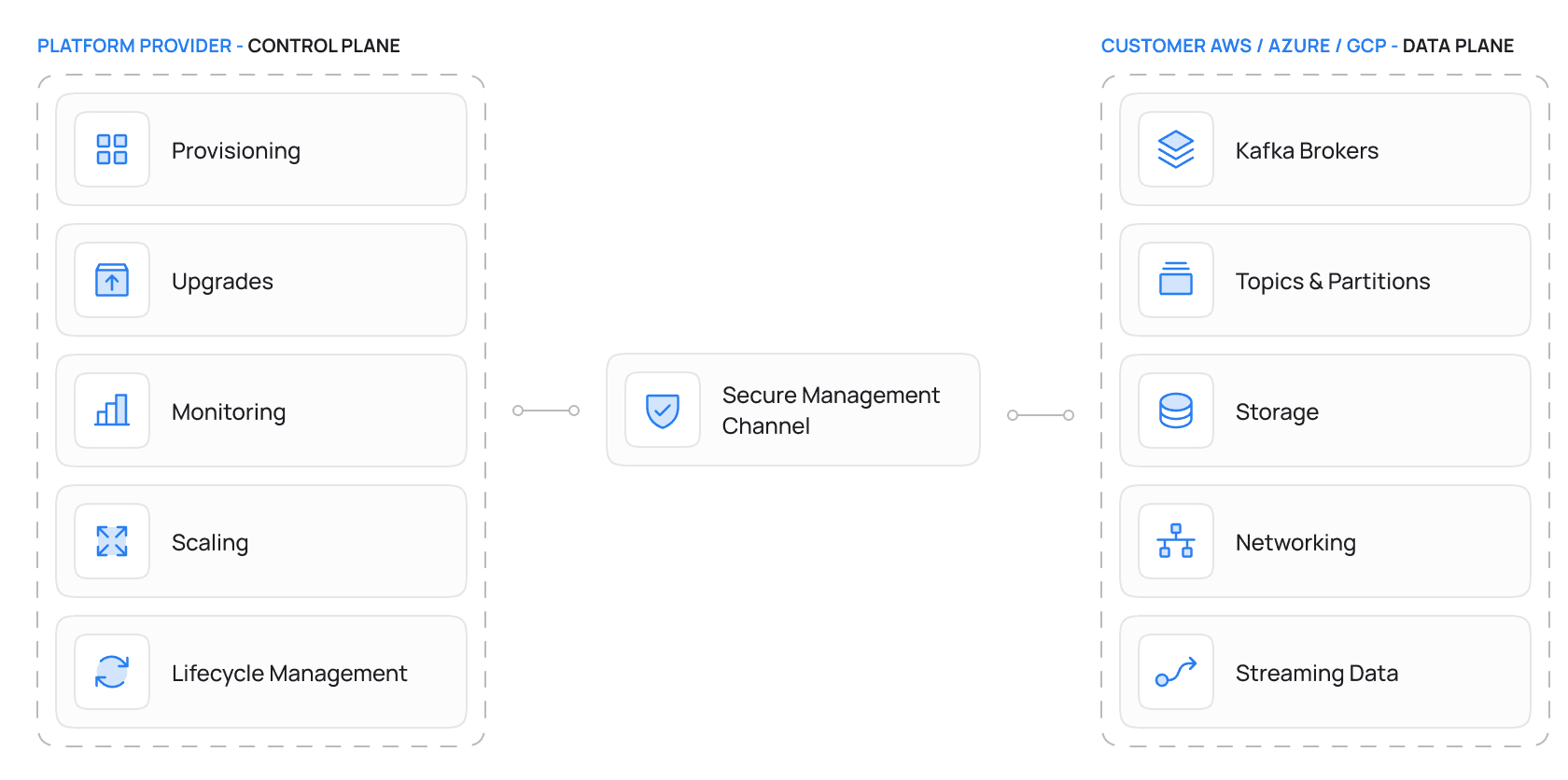
This separation enables organizations to retain complete ownership of their infrastructure and data without taking on the operational complexity of managing Apache Kafka themselves.
How Condense Delivers BYOC Kafka
Condense delivers BYOC Kafka as part of its unified, AI-assisted application platform for real-time data streaming. Rather than offering managed Kafka as a standalone service, Condense deploys Kafka directly into the customer's AWS, Microsoft Azure, or Google Cloud environment while managing the operational lifecycle through its control plane.
Beyond Kafka operations, Condense provides the capabilities required to build and run production-grade streaming applications. Engineering teams can develop stream processing applications, integrate enterprise and IoT data sources, deploy workloads, monitor application health, and manage the complete lifecycle of data streaming applications from a single platform. This enables organizations to retain full ownership of their infrastructure while accelerating the development and operation of enterprise-scale streaming solutions.
If you'd like to understand how the BYOC deployment model works behind the scenes, read our detailed architecture guide How does Bring Your Own Cloud (BYOC) Work
Data Sovereignty and Compliance Are Driving BYOC Adoption
For many enterprises, the decision to adopt BYOC Kafka extends beyond operational efficiency. As governments introduce stricter privacy regulations and organizations expand across multiple regions, maintaining control over where data is stored, processed, and transmitted has become a strategic requirement.
Traditional vendor-hosted Kafka deployments can complicate compliance because data often resides within infrastructure owned and managed by the service provider. Even when providers offer regional deployments, organizations may have limited visibility into how data is processed, where backups are stored, or how network traffic flows between cloud environments. For regulated industries, this lack of control can introduce additional compliance reviews, governance challenges, and operational risks.
By keeping the Kafka data plane inside the customer's own cloud account, BYOC Kafka gives organizations complete visibility and ownership of their streaming infrastructure. Security policies, network configurations, encryption standards, and access controls remain under the organization's governance, making it easier to align Kafka deployments with internal security frameworks and regulatory obligations.
Meeting Data Residency Requirements
Many countries now require certain categories of data to remain within specific geographic boundaries. Whether processing customer information, financial transactions, healthcare records, or government data, organizations must be able to demonstrate where data resides and who controls the underlying infrastructure.
With BYOC Kafka, Kafka brokers, storage volumes, and streaming data remain within the organization's chosen cloud region. Enterprises decide where workloads are deployed, helping them satisfy regional data residency requirements without changing how applications consume or produce events.
Supporting GDPR and the Digital Personal Data Protection Act (DPDP)
Regulations such as the General Data Protection Regulation (GDPR) in the European Union and India's Digital Personal Data Protection (DPDP) Act place significant responsibilities on organizations handling personal data. These regulations require organizations to implement appropriate technical and organizational measures to protect data, maintain governance, and demonstrate compliance.
While compliance depends on an organization's overall security and operational practices, BYOC Kafka provides a deployment model that supports these objectives by allowing enterprises to keep sensitive data within infrastructure they own and manage. This simplifies governance, strengthens audit readiness, and provides greater transparency into how streaming data is processed.
To learn more about securing enterprise streaming platforms, read our guide on Kafka Security for the Enterprise: Building Trust in Motion.
Why Regulated Industries Prefer BYOC
Industries handling highly sensitive or business-critical information often have stricter governance requirements than general cloud workloads.
Examples include:
Banking and Financial Services (BFSI), where payment data and financial transactions require strong governance and auditability.
Healthcare, where patient information must be protected according to industry regulations and organizational security policies.
Government and Public Sector, where data sovereignty and infrastructure ownership are often mandatory.
Manufacturing and Industrial IoT, where operational data, production telemetry, and intellectual property represent strategic business assets.
For these organizations, BYOC Kafka provides a practical balance between managed operations and complete infrastructure ownership. Rather than choosing between operational simplicity and regulatory compliance, enterprises can achieve both through a deployment model that keeps streaming data securely within their own cloud environment.
For a deeper look at how this approach addresses regulatory requirements, explore How BYOC Managed Kafka Solves Compliance and Data Residency Challenges.
Why BYOC Eliminates Kafka Egress Costs
Cloud costs are often associated with compute, storage, and managed services, but one of the most overlooked expenses in large-scale Kafka deployments is network egress. As organizations stream millions of events between applications, analytics platforms, data lakes, and AI workloads, the cost of moving data across cloud boundaries can quickly become one of the largest operational expenses.
In a traditional vendor-hosted Kafka deployment, applications frequently communicate with Kafka clusters running outside the organization's cloud account. Every event published to or consumed from Kafka may traverse cloud networks, resulting in data transfer charges that increase with application growth, consumer groups, and streaming volumes.
For organizations processing terabytes of streaming data every day, these network costs can grow significantly over time, often exceeding initial infrastructure estimates.
Understanding Cloud Network Egress
Cloud providers generally do not charge for data entering their platforms, commonly referred to as ingress. However, data leaving a cloud environment or moving between regions, availability zones, or cloud providers is typically billed as network egress.
For Apache Kafka, every producer publishing events and every consumer reading those events generates network traffic. As additional downstream systems such as analytics platforms, machine learning pipelines, data warehouses, and operational applications consume the same event streams, the volume of outbound traffic continues to increase.
This means network costs often scale with the success of the platform rather than remaining fixed.
Why Vendor-Hosted Kafka Increases Network Costs
Consider a common enterprise architecture where business applications are deployed inside the organization's AWS environment, while Kafka is hosted by a third-party provider.
Every producer sends data to the vendor-managed Kafka cluster, and every downstream application retrieves that data across cloud boundaries. As event throughput increases, organizations pay not only for Kafka itself but also for the continuous movement of streaming data between environments.
For high-volume workloads, these recurring network charges can become a significant contributor to the total cost of ownership.
How BYOC Kafka Reduces Egress Costs
With BYOC Kafka, Kafka brokers run directly inside the customer's AWS, Microsoft Azure, or Google Cloud environment. Producers, consumers, databases, analytics platforms, AI services, and enterprise applications communicate over private cloud networking instead of sending traffic across external environments.
Customer Cloud (AWS / Azure / Google Cloud)
Because applications and Kafka operate within the same cloud environment, organizations significantly reduce cross-cloud network traffic and the associated egress charges. At the same time, they benefit from lower latency, improved network performance, and greater control over how streaming data flows through the enterprise.
As streaming adoption expands across business units and more applications consume real-time events, these savings become increasingly valuable. Rather than paying repeatedly to move data between environments, organizations can keep data close to the applications that use it, creating a more efficient, secure, and cost-effective streaming architecture.
How Condense Delivers BYOC Kafka and the Complete Data Streaming Lifecycle
BYOC Kafka provides the deployment model enterprises need to retain ownership of their infrastructure, networking, and data. However, deploying Kafka inside your cloud is only one part of building a successful real-time data streaming platform. Engineering teams still need to develop streaming applications, integrate enterprise systems, process data in real time, deploy workloads, monitor production environments, and continuously evolve applications as business requirements change.
Condense goes beyond managed Kafka by providing BYOC Kafka as part of a unified, AI-assisted application platform for real-time data streaming. Rather than assembling separate tools for application development, stream processing, deployment, observability, and operations, engineering teams can manage the complete lifecycle of their streaming applications through a single platform while keeping Kafka and all streaming data inside their own cloud environment.
Deploy BYOC Kafka in Your Cloud
Condense deploys Kafka directly into the customer's AWS, Microsoft Azure, or Google Cloud environment using a Bring Your Own Cloud (BYOC) architecture. Kafka brokers, storage, networking, topics, and streaming data remain entirely within the customer's cloud account, while Condense automates platform provisioning, upgrades, monitoring, scaling, and lifecycle management through its managed control plane.
This deployment model enables organizations to maintain complete ownership of their infrastructure without assuming the operational complexity of managing Kafka clusters themselves.
Build Production-Grade Streaming Applications
Running Kafka is only the foundation of a real-time streaming platform. Organizations also need to transform streaming data into business outcomes.
Condense provides a unified development environment for building event-driven applications that process, enrich, correlate, and route streaming data. Whether developing fraud detection systems, connected vehicle platforms, inventory management solutions, industrial IoT applications, or real-time analytics pipelines, engineering teams can build and deploy production-ready applications without stitching together multiple frameworks or operational tools.
Manage the Complete Application Lifecycle
Condense supports the complete lifecycle of enterprise data streaming applications from development to production.
Teams can:
Develop stream processing applications using an integrated browser-based IDE.
Connect enterprise systems, databases, cloud services, and IoT devices through production-ready connectors.
Deploy applications consistently across development, testing, and production environments.
Monitor application health, throughput, latency, and operational metrics from a centralized interface.
Autonomously scale streaming workloads as application demand grows.
By bringing development, deployment, operations, and lifecycle management together on a single platform, Condense enables engineering teams to focus on delivering business value instead of integrating and maintaining multiple technologies across the streaming stack.
Learn more about how organizations keep their streaming infrastructure inside their own cloud in Your Data on Your Cloud Using BYOC with Condense.
Vendor-Hosted Kafka vs. BYOC Kafka
Choosing between a traditional vendor-hosted Kafka service and a BYOC Kafka deployment depends on an organization's priorities. While both approaches simplify Kafka operations, they differ significantly in terms of infrastructure ownership, data sovereignty, compliance, networking costs, and operational flexibility.
Vendor-hosted Kafka is well suited for organizations seeking a quick path to adoption with minimal infrastructure responsibility. In contrast, BYOC Kafka provides the same managed experience while allowing enterprises to retain ownership of their cloud infrastructure, security policies, networking, and streaming data.
The table below highlights the key differences.
Capability | Vendor-Hosted Kafka | BYOC Kafka |
|---|---|---|
Infrastructure Ownership | Provider-owned infrastructure | Customer-owned infrastructure |
Kafka Deployment | Runs in the provider's cloud environment | Runs inside the customer's AWS, Microsoft Azure, or Google Cloud environment |
Control Plane | Managed by the provider | Managed by the provider |
Data Plane | Hosted by the provider | Hosted entirely within the customer's cloud |
Data Sovereignty | Limited control over data location | Complete ownership of data and infrastructure |
Data Residency | Depends on provider-supported regions | Customer selects cloud provider and deployment region |
Compliance | Shared responsibility with provider | Easier alignment with enterprise security and regulatory requirements |
Network Egress Costs | Higher due to cross-cloud data movement | Reduced by keeping traffic within the customer's cloud network |
Infrastructure Visibility | Limited | Full visibility into cloud resources |
Security Controls | Primarily provider-managed | Customer-managed security policies, IAM, networking, and encryption |
Vendor Lock-In | Higher | Lower, with greater architectural flexibility |
Operational Management | Managed by the provider | Managed by the provider through the control plane while infrastructure remains customer-owned |
Best Fit | Startups, prototypes, and smaller deployments | Enterprises, regulated industries, and large-scale production workloads |
There is no universal deployment model that fits every organization. Vendor-hosted Kafka remains a practical choice for teams prioritizing rapid adoption and minimal infrastructure management. However, as organizations scale their streaming platforms, handle sensitive data, or operate under strict regulatory requirements, BYOC Kafka provides greater control over infrastructure, stronger data sovereignty, improved compliance, and lower long-term networking costs without sacrificing the operational benefits of a managed platform.
Planning your own deployment? This guide explains how to design scalable BYOC architectures for enterprise Kafka workloads Designing BYOC Architectures for Real-Time Kafka Deployments
Is BYOC Kafka Right for Your Organization?
BYOC Kafka is not simply another deployment option. It is an architectural choice that balances the operational simplicity of managed Kafka with the control, security, and flexibility of customer-owned cloud infrastructure. Whether it is the right fit depends on an organization's regulatory obligations, data sensitivity, cloud strategy, and long-term operational goals.
Organizations That Benefit Most from BYOC Kafka
BYOC Kafka is particularly valuable for enterprises that process large volumes of business-critical or regulated data and require complete control over their cloud infrastructure.
It is well suited for:
Financial Services (BFSI): Protecting payment data, transaction streams, and customer information while meeting strict regulatory and audit requirements.
Healthcare: Processing patient records and healthcare data within controlled cloud environments to support privacy and compliance obligations.
Manufacturing and Industrial IoT: Keeping operational telemetry, production data, and intellectual property inside enterprise cloud environments while supporting real-time analytics.
Retail and eCommerce: Streaming customer, inventory, and order events without introducing unnecessary cross-cloud data movement.
Government and Public Sector: Maintaining complete ownership of infrastructure and data to satisfy sovereignty and security requirements.
Organizations pursuing multi-cloud or hybrid cloud strategies can also benefit from BYOC Kafka by aligning deployments with their existing cloud architecture instead of moving workloads into a provider-managed environment.
When Vendor-Hosted Kafka May Be Enough
Vendor-hosted Kafka remains a practical choice for many organizations, particularly when speed of adoption is the primary objective.
It may be suitable for:
Proof-of-concept projects and pilot implementations.
Internal applications with limited compliance requirements.
Development and testing environments.
Small-scale streaming workloads where data sovereignty and network egress costs are not significant concerns.
As streaming platforms evolve into business-critical infrastructure, however, enterprise priorities often shift toward long-term governance, infrastructure ownership, compliance, and cost optimization. At that stage, BYOC Kafka provides a deployment model that offers greater flexibility without sacrificing the operational advantages of managed Kafka.
Ultimately, the decision is not simply about where Kafka runs. It is about choosing a deployment model that aligns with your organization's security policies, regulatory requirements, cloud strategy, and future growth. For enterprises building long-term, production-grade streaming platforms, BYOC Kafka provides a strong foundation for balancing operational efficiency with complete ownership of infrastructure and data.