Developers
Company
Resources
Developers
Company
Resources

/

Choose the Right Data Streaming Platform.

Most platforms focus on streaming data, Condense focuses on understanding it. It’s not just managed Kafka; it’s Kafka with context. Infused with domain intelligence, Condense transforms raw streams into decisions, automations, and impact, because the right Kafka platform should understand what it’s moving
Trusted by Data teams around the world

Unbiased Simplified Comparison

How does Condense compare against Confluent?

TL;DR

Condense and Confluent Cloud both handle GBps-level throughput, but Condense provides a complete autonomous environment that Confluent lacks. Confluent Cloud is a managed infrastructure service that still leaves the heavy lifting to the user llike scaling external Flink clusters and paying high egress fees to move data into a vendor network. Condense solves the entire lifecycle by merging high-performance brokers with a native execution layer for Java, Python, or Go code. Since it runs on customer cloud, the platform scales brokers and logic automatically as one, finally cutting out the need for separate processing clusters and the hidden costs of moving data between networks.

Architecture

Ecosystem

Support & Compliance

FeatureCondenseConfluent
System DesignA unified environment that bundles Kafka, Kubernetes, and the App Runtime into one integrated stack.App-Fabric: Not a single binary, but a unified modular stack that bundles Kafka, Kubernetes, and streaming App Runtime.A cloud-native tiered architecture that uses the proprietary Kora engine to disaggregate compute from storage for elastic, multi-tenant scaling.
Platform ModelUnified Application Fabric: Merges the Kafka engine with a native event-driven microservice runtime. It is an "Execution Fabric."Infrastructure Suite: A collection of separate distributed services (Kafka, Flink, Registry) that must be integrated by the user.
Scaling ScopeFull-Stack Autonomy: Automatically scales brokers, connectors, and custom-code transforms (Java/Python/Go) based on real-time consumer lag.Infrastructure-Centric and Broker-Level Scaling: Efficiently scales cluster nodes, but scaling the processing power for custom code or microservices remains a manual or external engineering task
Cloud StorageNative Object Storage: Direct offloading to S3/GCS/Azure Blob; data stays in your buckets for infinite retention.Kora Engine (Proprietary): Proprietary serverless storage engine with high-performance tiered abstraction.
Enterprise BYOCNative First: 100% of the data plane, including the app logic, lives in your private cloud account.Split Control Plane: WarpStream (BYOC) exists but depends on Confluent's external control plane for metadata.
PerformanceApplication logic runs "local" to the broker, eliminating the network latency of external processors.Best-in-class for GBps+ global throughput and multi-region synchronization but subject to variability caused by network overhead in multi-tenant SaaS.

Architecture

Ecosystem

Support & Compliance

FeatureCondenseConfluent
System DesignA unified environment that bundles Kafka, Kubernetes, and the App Runtime into one integrated stack.App-Fabric: Not a single binary, but a unified modular stack that bundles Kafka, Kubernetes, and streaming App Runtime.A cloud-native tiered architecture that uses the proprietary Kora engine to disaggregate compute from storage for elastic, multi-tenant scaling.
Platform ModelUnified Application Fabric: Merges the Kafka engine with a native event-driven microservice runtime. It is an "Execution Fabric."Infrastructure Suite: A collection of separate distributed services (Kafka, Flink, Registry) that must be integrated by the user.
Scaling ScopeFull-Stack Autonomy: Automatically scales brokers, connectors, and custom-code transforms (Java/Python/Go) based on real-time consumer lag.Infrastructure-Centric and Broker-Level Scaling: Efficiently scales cluster nodes, but scaling the processing power for custom code or microservices remains a manual or external engineering task
Cloud StorageNative Object Storage: Direct offloading to S3/GCS/Azure Blob; data stays in your buckets for infinite retention.Kora Engine (Proprietary): Proprietary serverless storage engine with high-performance tiered abstraction.
Enterprise BYOCNative First: 100% of the data plane, including the app logic, lives in your private cloud account.Split Control Plane: WarpStream (BYOC) exists but depends on Confluent's external control plane for metadata.
PerformanceApplication logic runs "local" to the broker, eliminating the network latency of external processors.Best-in-class for GBps+ global throughput and multi-region synchronization but subject to variability caused by network overhead in multi-tenant SaaS.

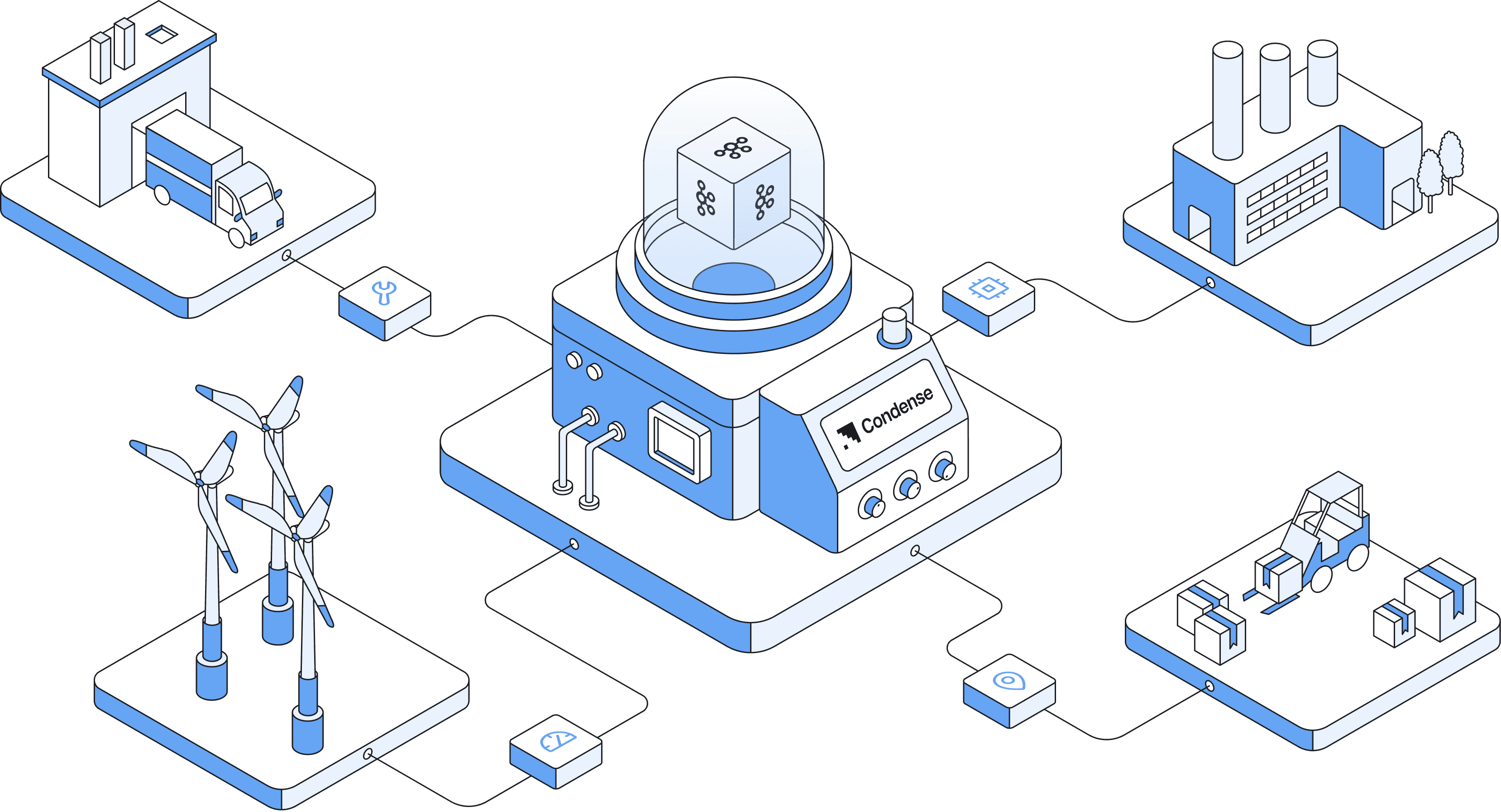
Condense: The Vertical Data Platform for Real-Time Businesses

Condense understands vertical data by design and connects directly to real time data sources
like vehicles or GDS platforms. Its purpose-built industry specific  connectors and transformations accelerate the development of real-time vertical use case

Condense understands vertical data by design and connects directly to real time data sources like vehicles or GDS platforms. Its purpose-built industry specific  connectors and transformations accelerate the development of real-time vertical use case

Condense understands vertical data by design and connects directly to real time data sources like vehicles or GDS platforms. Its purpose-built industry specific  connectors and transformations accelerate the development of real-time vertical use case

Accelerate the path from idea to production

Rapidly realize and deploy industry use cases

Enterprise scale with native governance

Optimize TCO through vertical industry-first approach
Condense - A Vertical Data Platform

Why Switch to Condense?

Native Data Sovereignty (BYOC Architecture)

Legacy SaaS models require data to exit your secure perimeter to reside in a vendor-owned account, introducing egress costs and compliance risks.

Condense is architected for Bring Your Own Cloud (BYOC). It deploys directly from cloud marketplaces into your private VPC (AWS, Azure, or GCP). This ensures that 100% of your data residency remains within your control, inherits your existing IAM/KMS security policies, and eliminates the "SaaS Tax" of cross-network data transfer fees.

Autonomous Full-Stack
Scaling

In a standard streaming architecture, scaling is reactive and siloed brokers are scaled based on disk/CPU, while processing apps are scaled via Kubernetes HPA.

Condense introduces Autonomous Scaling for the entire lifecycle. Through its Custom Transform Framework (CTF), the platform monitors throughput and lag at the event level. It automatically provisions compute resources for your custom Java or Python transforms and connectors, ensuring that your application logic scales in perfect lockstep with your Kafka brokers without manual intervention.

Verticalized vs. Horizontal
Ecosystem

While general-purpose platforms offer generic connectors, they leave the domain-specific logic to the user.

Condense bridges this gap with a Verticalized Ecosystem. It provides pre-built, domain-aware transforms for high-stakes industries such as Mobility (Trip Formation/VIN Parsing), Industrial IoT (Telemetry Cleansing), and FinTech (Anomaly Scoring). By combining these with a robust library of generic connectors, teams achieve a significantly faster Time-to-Market (GTM) by bypassing months of boilerplate code development.

Integrated Developer Workflow (The AI IDE)

Condense removes "Integration Sprawl" by embedding a Full-Code IDE directly into the platform.

Developers can write, test, and publish production-grade transforms in their preferred languages (Java, Python, Go) with built-in GitOps support. This environment is augmented by an Agentic AI Layer that assists in code generation and provides real-time root-cause analysis, reducing the engineering effort required to maintain complex streaming pipelines by up to 90%.

Evolution from Infrastructure to Application Platform

The primary limitation of traditional managed Kafka is the "operational gap." While legacy providers host the brokers, engineering teams are still responsible for the secondary layers: scaling processing clusters, managing containerized microservices for transforms, and wiring up external observability.

Condense collapses these layers into a unified Streaming Application Substrate. It provides an event-driven runtime that treats both the infrastructure and the application logic as a single, managed entity, allowing developers to focus purely on business logic rather than pipeline scaffolding.
Verticalized vs. Horizontal
Ecosystem

While general-purpose platforms offer generic connectors, they leave the domain-specific logic to the user.

Condense bridges this gap with a Verticalized Ecosystem. It provides pre-built, domain-aware transforms for high-stakes industries such as Mobility (Trip Formation/VIN Parsing), Industrial IoT (Telemetry Cleansing), and FinTech (Anomaly Scoring). By combining these with a robust library of generic connectors, teams achieve a significantly faster Time-to-Market (GTM) by bypassing months of boilerplate code development.

Evolution from Infrastructure to Application Platform

The primary limitation of traditional managed Kafka is the "operational gap." While legacy providers host the brokers, engineering teams are still responsible for the secondary layers: scaling processing clusters, managing containerized microservices for transforms, and wiring up external observability.

Condense collapses these layers into a unified Streaming Application Substrate. It provides an event-driven runtime that treats both the infrastructure and the application logic as a single, managed entity, allowing developers to focus purely on business logic rather than pipeline scaffolding.

Evolution from Infrastructure to Application Platform

The primary limitation of traditional managed Kafka is the "operational gap." While legacy providers host the brokers, engineering teams are still responsible for the secondary layers: scaling processing clusters, managing containerized microservices for transforms, and wiring up external observability.

Condense collapses these layers into a unified Streaming Application Substrate. It provides an event-driven runtime that treats both the infrastructure and the application logic as a single, managed entity, allowing developers to focus purely on business logic rather than pipeline scaffolding.

Integrated Developer Workflow (The AI IDE)

Condense removes "Integration Sprawl" by embedding a Full-Code IDE directly into the platform.

Developers can write, test, and publish production-grade transforms in their preferred languages (Java, Python, Go) with built-in GitOps support. This environment is augmented by an Agentic AI Layer that assists in code generation and provides real-time root-cause analysis, reducing the engineering effort required to maintain complex streaming pipelines by up to 90%.

Integrated Developer Workflow (The AI IDE)

Condense removes "Integration Sprawl" by embedding a Full-Code IDE directly into the platform.

Developers can write, test, and publish production-grade transforms in their preferred languages (Java, Python, Go) with built-in GitOps support. This environment is augmented by an Agentic AI Layer that assists in code generation and provides real-time root-cause analysis, reducing the engineering effort required to maintain complex streaming pipelines by up to 90%.

Why is Condense the Best Way to Enable Agentic AI and Real-Time Data

Connectors

App Lifecycle

Monitoring

Infra & Ops

WITHOUT CONDENSE

Coding Connectors

Requires specialized Java/Scala skills
to write and maintain industry specific connectors

Complex Management

Development and maintenance of ever changing industry connectors becomes difficult

Maintenance & Scalability

Managing scale and failover of connectors become a challenge as the load increases

THE CONDENSE WAY

Universal & Industry-Ready Connectors

Deploy universal or specialized connectors
(e.g., Telematics for Mobility) that come with built-in parsing for complex schemas

Configurable Output Sinks

Configure and deploy pre-built sink/source connectors and through UI into the data pipeline

Connectors

App Lifecycle

Monitoring

Infra & Ops

WITHOUT CONDENSE

Coding Connectors

Requires specialized Java/Scala skills
to write and maintain industry specific connectors

Complex Management

Development and maintenance of ever changing industry connectors becomes difficult

Maintenance & Scalability

Managing scale and failover of connectors become a challenge as the load increases

THE CONDENSE WAY

Universal & Industry-Ready Connectors

Deploy universal or specialized connectors
(e.g., Telematics for Mobility) that come with built-in parsing for complex schemas

Configurable Output Sinks

Configure and deploy pre-built sink/source connectors and through UI into the data pipeline

Connectors

App Lifecycle

Monitoring

Infra & Ops

WITHOUT CONDENSE

Coding Connectors

Complex Management

Maintenance & Scalability

THE CONDENSE WAY

Universal & Industry-Ready Connectors

Configurable Output Sinks

Get Started with Condense in 3 Simple Steps

Deploy Condense from Your Cloud Marketplace

01

Deploy

Deploy Condense from Your Cloud Marketplace

01

Deploy

Deploy Condense from Your Cloud Marketplace

01

Deploy

Create Your First Workspace

02

Create

Create Your First Workspace

02

Create

Create Your First Workspace

02

Create

Build Your First Real‑Time Pipeline

03

Build

Build Your First Real‑Time Pipeline

03

Build

Build Your First Real‑Time Pipeline

03

Build

Frequently Asked Questions

Frequently
Asked Questions