
TL;DR
BYOC Bring Your Own Cloud is a deployment model where a software vendor provisions and manages infrastructure entirely inside your cloud account, rather than in a shared vendor environment. Traditional SaaS relies on a simple, centralized trade-off that is vendor hosts the software, handles the updates, and manages the infrastructure. However, this model requires data to leave the customer’s security perimeter, moving into the vendor’s cloud account for processing and storage. For enterprises handling high-scale telemetry or regulated data, this "black box" approach triggers complex compliance audits, security risks, and unpredictable egress costs.
Bring Your Own Cloud (BYOC) inverts this model. It decouples the management of the software from the physical location of the data, allowing the vendor to operate the service while the runtime environment stays within the customer’s cloud account.
Security in a BYOC deployment uses the customer's own IAM roles, encryption keys, and network policies the vendor never has standing access to customer data.
How BYOC Actually Works
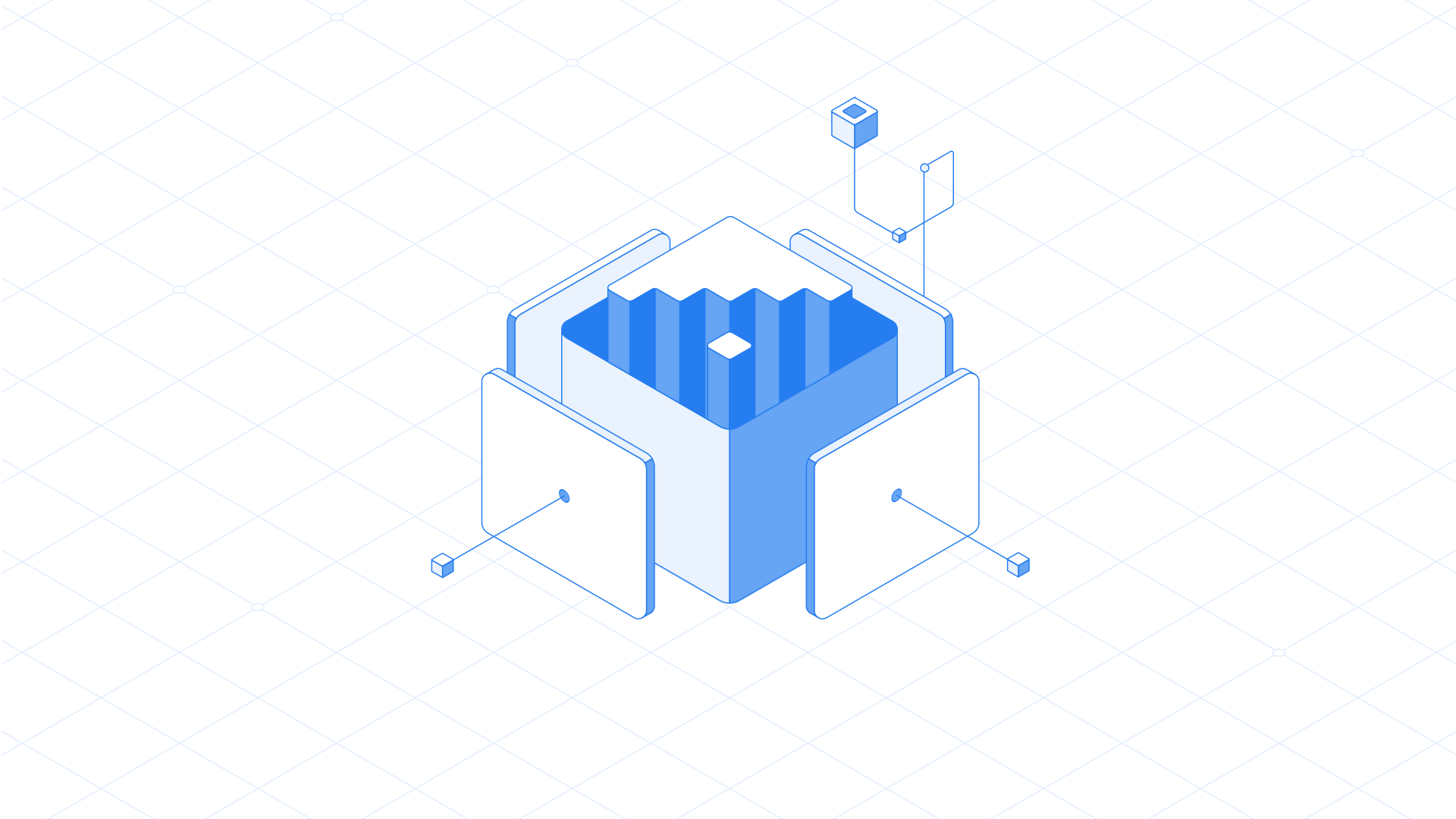
A BYOC deployment typically involves three layers: the customer's VPC, the vendor's control plane, and the data plane running inside the customer's account. BYOC functions through a split-plane design that prioritizes data residency without sacrificing managed innovation:
The Control Plane (Vendor-Managed): This layer resides in the vendor’s infrastructure to handle orchestration, monitoring, and software updates. It serves as the management interface but never accesses raw data.
The Data Plane (Customer-Hosted): This layer is deployed directly inside a Virtual Private Cloud (VPC) on AWS, Azure, or GCP. It is typically provisioned via CloudFormation, Terraform, or ARM templates. Because all ingestion, processing, and storage occur here, data never leaves the established security boundary.
The Sovereignty Gap in Traditional BYOC
The BYOC model is particularly valuable for regulated industries ensuring Kafka data never crosses geographic or legal boundaries. While BYOC resolves the "where is my data" question, most providers offer what is essentially "Managed Kafka-as-a-Service." They handle the brokers and the uptime, but they stop at the infrastructure level. This creates a sovereignty gap where engineering teams are still forced to:
Build the Application Layer: Provision separate processing engines like Flink or Spark to transform data.
Write Custom "Plumbing": Develop thousands of lines of code for industry-specific protocols such as MQTT, CAN, or GPS.
Manage Integration Complexity: Handle the fragile connections between raw data streams and business logic.
In this scenario, data residency is achieved, but a massive DevOps and engineering burden remains.
Condense: A Unified Data Streaming Platform
Condense closes this gap by providing an AI-first, Kafka-native platform that manages both the infrastructure and the application layer. It delivers a serverless-like experience while remaining 100% inside a private cloud perimeter.
Financial Optimization via Cloud Marketplaces
Deploying Condense through the AWS, Azure, and GCP Marketplaces turns data infrastructure into a strategic financial asset:
Cloud Credit Utilization: Large enterprises can pay for the platform using existing cloud credits or committed-use contracts. This allows specialized software to be funded by pre-allocated budgets.
Direct Infrastructure Rates: Compute and storage costs are paid directly to the cloud provider at negotiated enterprise rates, eliminating vendor markups on hardware.
Zero Egress Fees: Since processing happens at the source inside the VPC, the high costs of moving data to an external SaaS are removed.
Engineering Speed with an Inbuilt IDE
Condense eliminates the need for external processing clusters by providing an inbuilt AI-driven IDE to handle the application layer natively:
Custom Transforms: Transformation logic is written in Python, Go, or TypeScript directly within the platform.
Agentic Layer: Specialized AI agents understand Kafka-native streaming. These agents assist in writing and scaling logic, turning raw data into operational workflows significantly faster than manual coding.
Industry-Ready Connectors: The platform includes connectors that understand raw data formats out of the box, removing the need for custom "glue code."
Absolute Sovereignty with Zero Operations
The platform resides in a private cloud but requires no manual infrastructure management:
Native Security Integration: The system inherits existing IAM roles and VPC firewalls automatically. Data is never moved-not for processing and not for AI training.
Automated Lifecycle: Condense handles auto-scaling, security patches, and failovers. This results in a 99.95% uptime SLA without requiring internal SRE intervention for Kafka brokers.
Conclusion
Generic BYOC platforms solve the infrastructure problem but leave application complexity as a hurdle for the enterprise. Condense provides the complete backbone handling Kafka management, AI-assisted logic creation, and cost optimization, all while ensuring custody of data is never surrendered. BYOC Kafka deployment is available at a flat monthly rate giving teams all the data sovereignty benefits without unpredictable costs.