Condense
Industry
Developers
Company
Resources
Condense
Industry
Developers
Company
Resources

/

Choose the Right
Data Streaming Platform.

Condense and Cloudera both address enterprise data streaming, but Cloudera relies on separate tools like NiFi, Kafka, and Flink, creating operational overhead. Condense replaces this with its AI-enabled Custom Transform Framework, a built-in IDE for developing, deploying, and managing stream processing within a single platform

Trusted by Data teams around the world

Unbiased Simplified Comparison

How does Condense compare against Cloudera?

TL;DR

Condense modernizes enterprise streaming by replacing Cloudera's multi-tool architecture with a unified, AI-powered streaming platform. Instead of managing separate components like NiFi, Kafka, and Flink, Condense combines streaming, processing, scaling, observability, and deployment into a single platform running entirely in your own cloud. The result is lower operational overhead, faster application delivery, predictable costs, and built-in support for industry-specific streaming use cases.

Architecture

Ecosystem

Support & TCO

FeatureCondenseCloudera (CDP/CDF)
System DesignA unified environment that bundles Kafka, Kubernetes, and the App Runtime into one integrated stackA distributed "Data Lakehouse" ecosystem that glues together independent tools like NiFi, Kafka, and Flink.
Unified PlatformManaged App Runtime: Custom transforms run in a managed, serverless-style environment. Condense handles containerization and stateTool-Chain Centric: Requires manual "wiring" of NiFi for ingestion, Kafka for transport, and Flink/Spark for processing.
Scaling ScopeFull-Stack Autonomy: Automatically scales brokers, connectors, and custom-code (Java/Python/Go) based on real-time loadSiloed Scaling: You must independently scale NiFi nodes, Kafka brokers, and Flink clusters, leading to "Scale Imbalance."
Cloud StorageNative Object Storage: Direct, high-speed offloading to your own S3/GCS buckets for infinite, sovereign retentionHDFS/Ozone Roots: Rooted in legacy HDFS architectures; while cloud-capable, it often adds complexity to native S3 paths.
Enterprise BYOC100% BYOC Native: Specifically engineered to run in your VPC to maintain 100% data and metadata sovereigntyHybrid-Cloud: Offers BYOC, but the management plane (Cloudera Manager) is heavy and requires significant infrastructure overhead.
PerformanceServerless Scale and Zero-Hop : Logic runs "local" to the broker, eliminating the network latency of moving data between toolsVariable: Subject to "Integration Latency" as data hops between NiFi, Kafka, and external compute clusters.

Condense: The Vertical Data Platform for Real-Time Businesses

Condense understands vertical data by design and connects directly to real time data sources
like vehicles or GDS platforms. Its purpose-built industry specific  connectors and transformations accelerate the development of real-time vertical use case

Condense understands vertical data by design and connects directly to real time data sources like vehicles or GDS platforms. Its purpose-built industry specific  connectors and transformations accelerate the development of real-time vertical use case

Accelerate the path from idea to production

Rapidly realize and deploy industry use cases

Enterprise scale with native governance

Optimize TCO through vertical industry-first approach
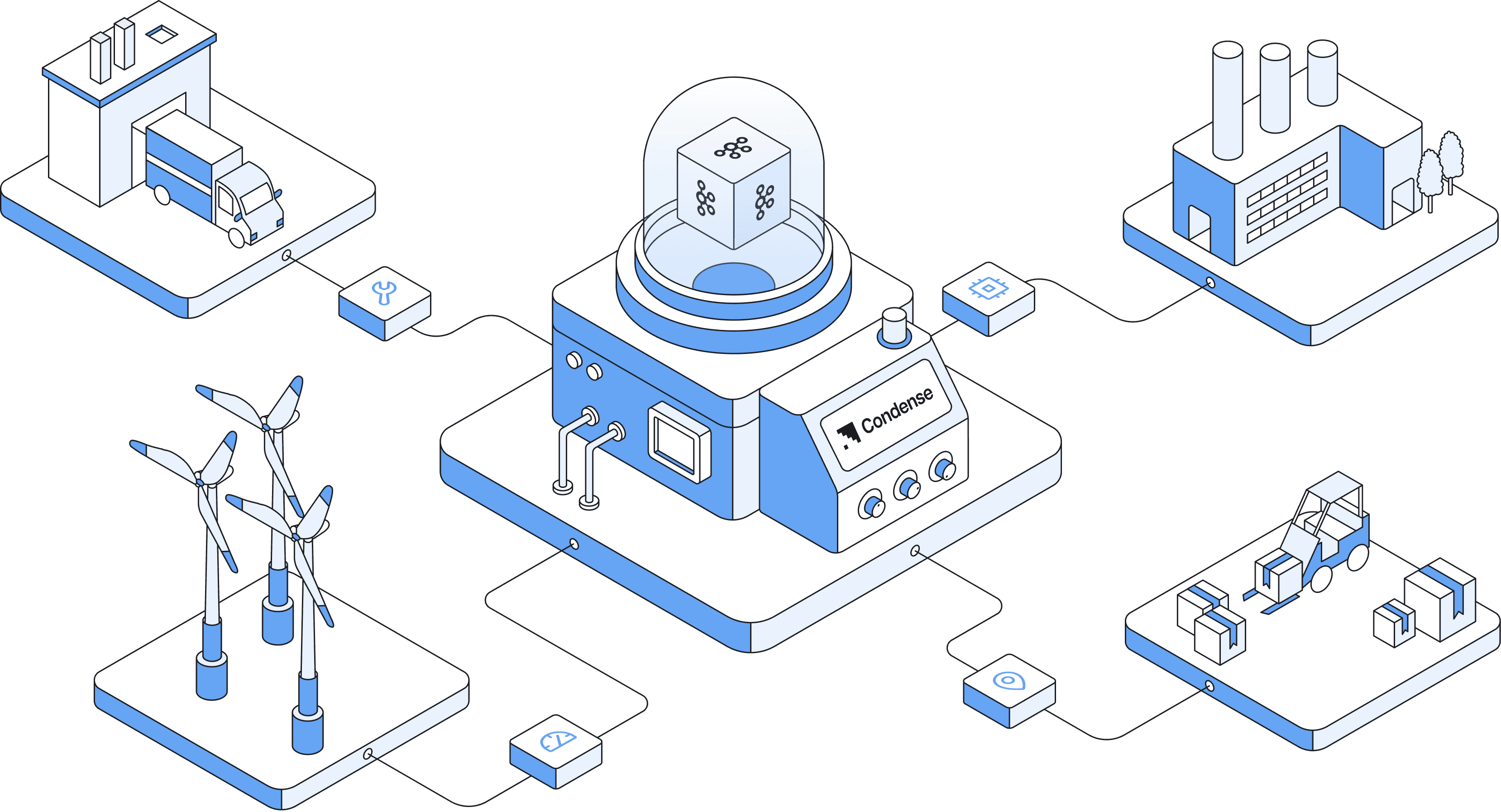
Condense - A Vertical Data Platform

Why Switch to Condense?

Transition from Tool-Chains
to a Unified App Runtime

Cloudera provides a "bag of parts" (NiFi, Kafka, Flink, Spark). To build one application, your data must hop through three different systems, each with its own security, networking, and scaling logic
Condense merges these into an Execution Fabric. It hosts both the brokers and the business logic in one place, allowing you to deploy production code without the "integration tax" of stitching legacy tools together

Full-Stack Autonomous
Scaling vs Manual Rebalancing

In Cloudera, scaling is a manual chore. If your NiFi ingestion is fast but your Flink processing is lagging, you have to manually resize clusters and rebalance partitions
Condense features Autonomous Scaling for the entire pipeline. It monitors real-time consumer lag and automatically provisions compute for the brokers and your custom logic in sync, ensuring the entire stack scales as a single unit

100% Sovereign BYOC vs Heavy Management Layers

Cloudera’s management layer (Cloudera Manager/CDP Control Plane) is massive and often requires external management components
Condense is 100% BYOC Native. Everything-brokers, runtime, and metadata—lives entirely inside your VPC. This ensures absolute data localization and security, fulfilling 2026's strictest compliance requirements without any data "phoning home"

Unified Developer Experience and Observability

Debugging a Cloudera pipeline involves jumping between NiFi's lineage UI, Kafka's broker logs, and Flink's dashboard.
Condense embeds a Full-Code IDE and AI-Assisted Layer directly into the platform. You get a single dashboard where you can trace an event from ingestion through your custom code to the final sink, reducing your Mean Time to Recovery (MTTR) from hours to minutes

From Horizontal Pipes to Vertical Industry Logic

Cloudera is a generic big-data platform. If you are in the Mobility or IoT sector, you have to spend months building every telematics parser or geofencing alert from scratch
Condense provides a Verticalized Ecosystem with pre-built, domain-aware transforms. You can use production-ready assets for industry-specific data, moving from prototype to production months faster than on Cloudera’s general-purpose stack

Why is Condense the Best Way to Enable Agentic AI and Real-Time Data

Connectors

App Lifecycle

Monitoring

Infra & Ops

WITHOUT CONDENSE

Coding Connectors

Requires specialized Java/Scala skills to write and maintain industry specific connectors

Complex Management

Development and maintenance of ever changing industry connectors becomes difficult

Maintenance & Scalability

Managing scale and failover of connectors become a challenge as the load increases

THE CONDENSE WAY

Universal & Industry-Ready Connectors

Deploy universal or specialized connectors
(e.g., Telematics for Mobility) that come with built-in parsing for complex schemas

Configurable Output Sinks

Configure and deploy pre-built sink/source connectors and through UI into the data pipeline

Connectors

App Lifecycle

Monitoring

Infra & Ops

WITHOUT CONDENSE

Coding Connectors

Complex Management

Maintenance & Scalability

THE CONDENSE WAY

Universal & Industry-Ready Connectors

Configurable Output Sinks

Get Started with Condense in 3 Simple Steps

Deploy Condense from Your Cloud Marketplace

01

Deploy

Deploy Condense from Your Cloud Marketplace

01

Deploy

Deploy from Your Cloud Marketplace

01

Deploy

Create Your First Workspace

02

Create

Create Your First Workspace

02

Create

Create Your First Workspace

02

Create

Build Your First Real‑Time Pipeline

03

Build

Build Your First Real‑Time Pipeline

03

Build

Build Your First Real‑Time Pipeline

03

Build

Frequently Asked Questions

Frequently
Asked Questions

While Open Source Kafka (OSS) requires you to manually provision and manage brokers, Managed BYOC (Bring Your Own Cloud) like Condense automates the operations while keeping the data in your account. You get the sovereignty of OSS with the automated scaling, patching, and 24/7 monitoring of a SaaS, all within your private VPC.

A standard broker only stores and moves data. An Execution Fabric (like Condense) unifies the broker with a native application runtime. This allows you to run Java/Python microservices directly on the same substrate as the data, eliminating the network latency (Zero-Hop) and the cost of external processing clusters like Flink or Spark.

Yes. Because Condense is a VPC-native platform, the underlying infrastructure (compute, storage, and networking) runs in your cloud account. This allows you to utilize your Enterprise Discount Programs (EDP) and cloud credits, unlike SaaS providers where you pay a marked-up price for their infrastructure.

Both provide high sovereignty, but Condense simplifies it. In a DIY Kafka OSS setup, you are responsible for hardening the security. Condense is "Sovereign-by-Design," meaning 100% of the data plane and application logic stays inside your security perimeter, inheriting your IAM roles and encryption keys automatically.

Absolutely. Condense is built on 100% native Apache Kafka. Any application, connector, or tool that works with Kafka OSS will work with Condense without any code changes. You gain the platform's advanced execution features without losing the flexibility of the Kafka ecosystem.

The "free" binary is the smallest part of the cost. The true Total Cost of Ownership (TCO) includes: - Hiring: A dedicated team of 3–5 Kafka SREs ($600k+/year). - Glue Code: Months spent building custom monitoring, CI/CD, and security. - Ops: Manual partition rebalancing and risk-heavy version upgrades. Condense typically reduces these operational costs by up to 60% through autonomous management.

Yes. Unlike the generic "dumb pipe" of Kafka OSS, Condense includes Vertical Blueprints. These are pre-built, domain-aware modules for Trip Building, VIN Decoding, and Geofencing for the Mobility sector, and VSS Mapping for IoT, significantly reducing time-to-market.