
TL;DR
Event-driven microservices are a specific implementation of event-driven architecture where individual services communicate through Kafka events rather than synchronous API calls.' The transition from monolithic architectures to microservices has solved many scaling issues but introduced a significant challenge: communication. Traditional REST-based communication creates tight coupling. If Service A must wait for a response from Service B, the system is only as fast as its slowest component.
Event-driven architecture (EDA) using Data Streaming Platforms (DSPs) solves this by allowing services to communicate asynchronously. In this model, services produce and consume events through a central stream. This guide explains how to build these systems and compares the traditional manual approach with the streamlined Condense managed approach.
What is an Event-Driven Microservice?
Each microservice interaction uses a specific Kafka pattern event notification for lightweight signals, event-carried state transfer for data-rich updates, and saga coordination for distributed transactions. In an event-driven system, a microservice does not call another service directly. Instead, it records a change in state as an "event" and publishes it to a DSP like Kafka. Other services that need this information subscribe to the relevant topic and process the data at their own pace.
This creates a decoupled environment where:
Services are independent: A failure in the consumer does not crash the producer.
Scaling is granular: You can scale the specific service that is under load.
Data is persistent: The DSP acts as a source of truth that can be replayed.
Step 1: Defining the Event Schema
Before writing code, you must define what an event looks like. An event typically consists of a key, a value, and a timestamp.
The Generic Way
In a standard setup, teams often use JSON for simplicity. However, JSON lacks strict enforcement. If a producer changes a field name, the consumer breaks. To fix this, teams implement a Schema Registry (like Confluent or Apicurio). Engineers must manually configure the registry, define Avro or Protobuf schemas, and ensure every service points to the correct registry URL.
The Condense Way
Condense treats schema management as a built-in governance feature. The platform manages the schema registry for you. When you define a data pipeline, the schema is version-controlled and enforced at the platform level.
This prevents "poison pills" (malformed data) from entering the stream without requiring the engineer to manage the registry infrastructure.
Step 2: Provisioning the Streaming Infrastructure
The DSP is the backbone of your architecture. It must be resilient and scalable.
The Generic Way
Setting up a production-ready Kafka cluster involves several manual steps:
Provisioning virtual machines or containers across multiple availability zones.
Configuring Zookeeper or KRaft for cluster coordination.
Setting up listeners, security protocols (TLS/SSL), and authentication (SASL).
Estimating throughput to decide on the number of brokers and partitions.
This process often takes weeks and requires a dedicated DevOps or Site Reliability Engineering (SRE) team.
The Condense Way
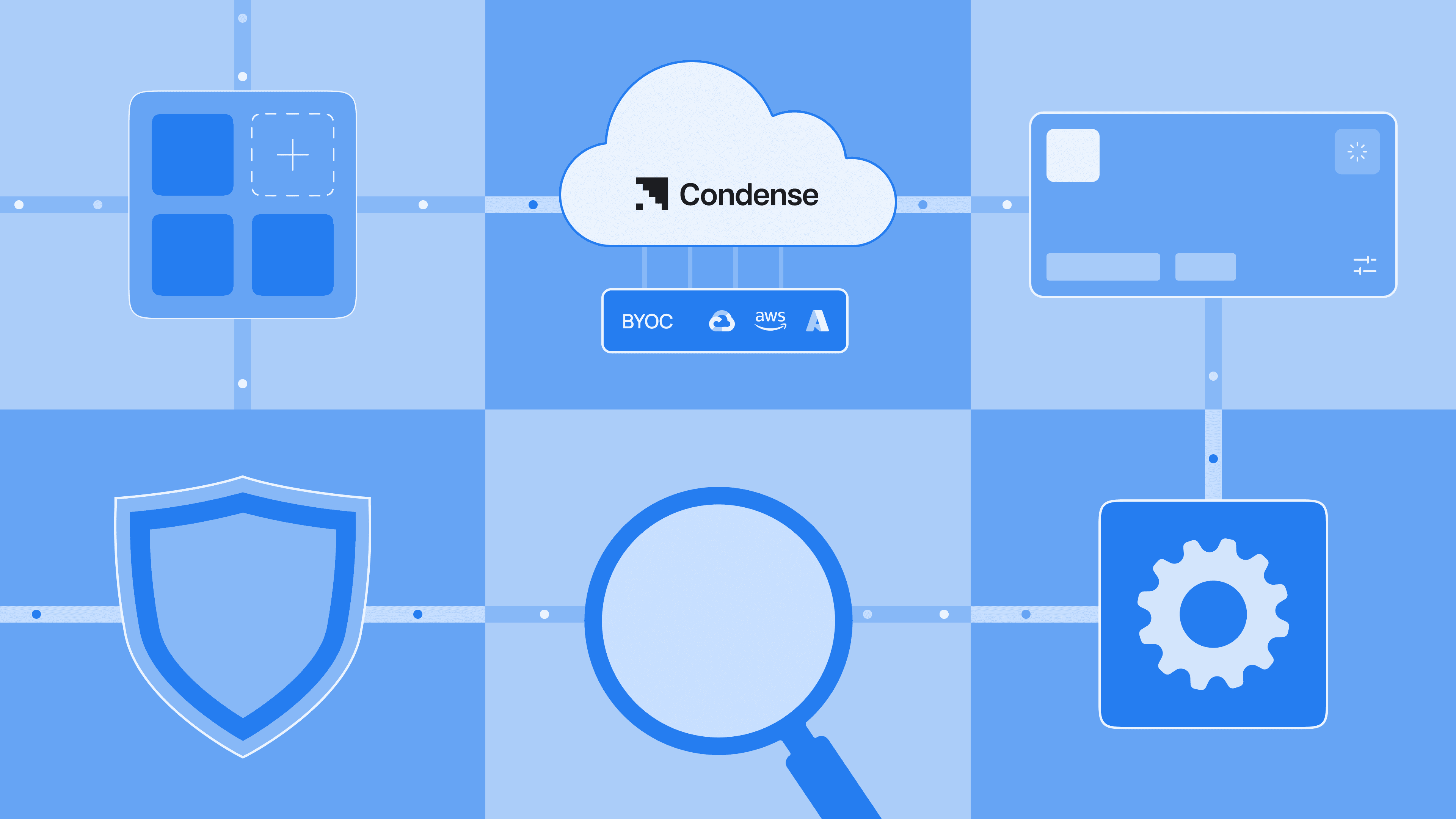
Condense uses a Managed Bring Your Own Cloud (BYOC) model. You provide the cloud credentials for your AWS, Azure, or GCP account. The platform then provisions the optimized Kafka infrastructure inside your private network. You get a production-ready cluster in minutes.
Because it is in your account, you do not pay the high service markups or data egress fees associated with third-party SaaS providers.
Step 3: Producing Events from Microservices
Once the infrastructure is ready, your services need to send data.
The Generic Way
Engineers must write producer logic using libraries like kafka-python or confluent-kafka-go. This requires handling retries, acknowledgments, and batching logic manually. If the service needs to transform data before sending it (e.g., stripping PII), that logic must be hard-coded into the microservice, increasing the size and complexity of the codebase.
The Condense Way
Condense offers Input Connectors and the Custom Transform Framework (CTF).
Connectors: If your data comes from standard sources like MQTT, HTTP, or Databases, you do not need to write producer code. You configure the connector, and the platform pulls the data.
CTF: If the data needs transformation, you can write a simple function in the Condense UI. The platform executes this transformation on the stream. This keeps your microservice code "clean" because the service only handles its core business logic.
Step 4: Consuming and Processing Events
A microservice consumes events to trigger actions, such as sending an email or updating a database.
The Generic Way
A standard consumer must manage "offsets." The consumer needs to track which messages it has already read. If the service crashes, it must know where to restart. Managing consumer groups and ensuring "exactly-once" processing requires deep knowledge of Kafka internals. Furthermore, if you need to join two streams of data, you must deploy a complex framework like Kafka Streams or Flink.
The Condense Way
Condense simplifies consumption through its Application Layer. You can build data pipelines using a visual interface or version-controlled blocks. For common tasks like filtering, splitting streams, or triggering alerts, you use No-Code Utilities.
This reduces the amount of boilerplate code your team has to write and maintain.
Comparison: Operational Reality
Feature | Generic Manual Kafka | Condense Managed BYOC |
Setup Time | Weeks or Months | Minutes |
Security | Manual TLS/SASL Config | Built-in RBAC and ACLs |
Scaling | Manual Partition Rebalancing | Automated Zero-Downtime Scaling |
Data Cost | High Egress Fees to SaaS | Zero Egress (Stays in your VPC) |
Maintenance | Requires 24/7 SRE Team | Fully Managed Platform |
Step 5: Observability and Monitoring
In event-driven microservices, distributed tracing and consumer lag monitoring are essential understanding how an event flows across multiple services requires end-to-end pipeline visibility. You cannot manage what you cannot see. In an event-driven system, you need to track "lag" the delay between when a message is produced and when it is consumed.
The Generic Way
You must install and configure external tools like Prometheus and Grafana. You have to export JMX metrics from every broker and set up custom alerts for consumer lag. When a pipeline fails, finding the root cause requires searching through raw logs across multiple servers.
The Condense Way
The Observability Layer is integrated into the platform. You see real-time dashboards of throughput, latency, and lag for every topic and consumer. If a pipeline breaks, the platform provides contextual insights.
You can see exactly which block in the pipeline failed, making troubleshooting significantly faster.
Step 6: Ensuring Data Sovereignty
As privacy laws like GDPR and DPDP become stricter, where your data lives matters.
The Generic Way
If you use a standard managed Kafka provider, your data often leaves your account and sits in the provider's cloud. This can create compliance issues and security risks. To avoid this, many companies choose to self-host, which brings back all the operational headaches mentioned earlier.
The Condense Way
Condense is designed for Data Sovereignty. The data plane where your events actually flow resides entirely within your VPC. The Condense management plane only sends instructions to your cluster. Your sensitive data never leaves your secure environment.
You get the ease of a managed service without giving up control of your data.
Step 7: Evolution and Version Control
Schema contracts between microservices are critical when one service changes its event structure, downstream consumers must be able to handle both old and new formats without breaking. Systems change over time. You will eventually need to update your logic or add new services.
The Generic Way
Updating a data pipeline in a traditional setup involves redeploying microservices. There is often no central record of how data flows through the system. If a new engineer joins the team, they must read through hundreds of lines of code to understand the architecture.
The Condense Way
Every component in a Condense pipeline is a version-controlled block. You can see a visual map of how data moves from Ingestion to Action. When you update a transformation or a connector, you can track the change in a git-like history.
This makes the system self-documenting and much easier to audit for compliance.
Conclusion: Core vs Chore
For a complete production blueprint covering Kafka topic design, partition strategy, and connector configuration for microservices see our full pipeline architecture guide. The decision to move to an event-driven microservices architecture is a strategic one. However, many companies get trapped in the "infrastructure tax." They spend their best engineering hours managing brokers, rebalancing partitions, and fighting egress fees.
The generic way of running Kafka requires you to be an infrastructure expert. The Condense way allows you to be a product expert. By offloading the foundational complexity to a platform that lives in your own cloud, you reclaim your team's time.
The goal of your engineering team is to write the proprietary logic that defines your business. Whether that is a recommendation engine, a logistics tracker, or a financial clearing system, your focus should be on the Application Layer. Condense ensures that the "pipes" are always ready, secure, and cost-effective, allowing you to build the future of your industry without being slowed down by the tools you use.