

TL;DR
Retail inventory management has evolved far beyond tracking products on warehouse shelves. Today's retailers operate across physical stores, eCommerce platforms, online marketplaces, distribution centers, and supplier networks, where inventory levels change continuously throughout the day. Every sale, return, warehouse transfer, supplier delivery, and inventory adjustment impacts product availability, making accurate inventory visibility essential for delivering a seamless customer experience.
However, many retailers still rely on scheduled synchronization between Point-of-Sale (POS) systems, Warehouse Management Systems (WMS), Enterprise Resource Planning (ERP) platforms, and online storefronts. While these systems perform different functions, they all depend on accurate inventory data. When updates occur only every few minutes, hourly, or overnight, each application gradually develops its own view of inventory, leading to inconsistent stock levels across the business.
This lack of synchronization creates operational challenges that extend beyond inventory accuracy. Customers may order products that are no longer available, store associates struggle to locate stock, replenishment teams react too late to changing demand, and forecasting models rely on outdated information. As retailers expand across multiple sales channels, traditional inventory synchronization becomes increasingly difficult to scale.
Apache Kafka addresses these challenges by enabling real-time inventory management through event streaming. Instead of periodically exchanging inventory data, every inventory movement is published as an event and shared immediately with the systems that need it. This event-driven approach keeps inventory synchronized across retail applications while enabling capabilities such as real-time stock tracking, proactive stockout detection, automated replenishment, and demand sensing.
In this guide, we'll explore how retailers use Apache Kafka to build scalable, event-driven inventory platforms, examine a production-ready reference architecture, and discuss implementation best practices for reducing stockouts and improving inventory visibility across the supply chain.
Why Traditional Inventory Management Creates Stockouts
Retail inventory changes continuously. Every customer purchase, online order, return, warehouse transfer, supplier delivery, and inventory adjustment affects product availability. While these events happen in real time, many retail systems still exchange inventory data on a fixed schedule, creating a gap between actual inventory and what different applications believe is available.
As retailers expand across physical stores, eCommerce platforms, marketplaces, and fulfillment centers, this delay becomes increasingly difficult to manage. Inventory may be available in one system but unavailable in another, leading to inconsistent stock visibility, delayed replenishment, and dissatisfied customers.
The Problem with Nightly Batch Inventory Synchronization
For years, retailers relied on batch processing to synchronize inventory between operational systems. Scheduled jobs, file transfers, or periodic API calls updated inventory at fixed intervals, often every hour or overnight. While this approach reduced integration complexity, it also meant inventory data remained outdated until the next synchronization cycle.
A typical retail ecosystem includes several independent systems, each maintaining its own inventory records.
Point-of-Sale (POS) systems
Warehouse Management Systems (WMS)
Enterprise Resource Planning (ERP) platforms
eCommerce applications
Supplier management systems
Mobile inventory applications
Without continuous synchronization, these systems gradually develop different views of inventory throughout the day.
Synchronization Method | Update Frequency | Business Impact |
|---|---|---|
Nightly batch jobs | Every 24 hours | Inventory remains outdated for most of the day. |
Hourly synchronization | Every 60 minutes | Delayed visibility into inventory changes. |
API polling | Every 5–30 minutes | Higher infrastructure overhead with stale data between polls. |
Event streaming | Continuous | Inventory is updated as business events occur. |
Even a short synchronization delay can have a significant business impact. During promotional campaigns or peak shopping periods, inventory may change hundreds of times before the next scheduled update, increasing the risk of overselling and stockouts.
Organizations moving away from scheduled synchronization often begin by replacing traditional ETL pipelines with streaming architectures. Learn how this transition works in our guide on Streaming ETL with Condense: A Faster, Smarter Alternative to Batch Processing.
How Inventory Becomes Inconsistent Across Retail Systems
Consider a retailer that starts the day with 150 units of a product in stock.
During the day, customers purchase products in-store, online orders reserve inventory, and warehouses replenish stock. Each system records these activities independently, but until the next synchronization cycle, every application reports a different inventory value.
Business Event | Actual Inventory | ERP | Online Store | POS |
|---|---|---|---|---|
Opening inventory | 150 | 150 | 150 | 150 |
12 products sold in-store | 138 | 150 | 150 | 138 |
8 online orders placed | 130 | 150 | 142 | 138 |
Warehouse replenishment received | 170 | 150 | 142 | 138 |
Scheduled synchronization | 170 | 170 | 170 | 170 |
For several hours, every system maintains a different inventory count. While the POS reflects recent sales, the ERP and online store continue operating with outdated information until synchronization completes.
This inconsistency creates several operational challenges.
Customers purchase products that are no longer available.
Online channels display incorrect stock levels.
Replenishment teams respond too late to inventory changes.
Store associates struggle to locate available inventory.
Safety stock increases to compensate for poor inventory visibility.
Demand forecasting relies on outdated inventory data.
As inventory volumes grow across multiple channels, these issues become increasingly difficult to solve using scheduled synchronization alone.
How Apache Kafka Enables Real-Time Inventory Management
Instead of synchronizing inventory databases at scheduled intervals, Apache Kafka enables retailers to process every inventory movement as an event the moment it occurs. Each business event—whether it's a product sale, customer return, warehouse transfer, or supplier delivery—is published to Kafka and made available to every downstream application in real time.
This event-driven approach ensures that inventory changes are shared continuously rather than periodically. As new events arrive, systems such as ERP, WMS, eCommerce platforms, analytics applications, and mobile inventory tools consume the same stream independently, allowing them to maintain a consistent view of inventory without relying on frequent database synchronization.
Beyond improving inventory visibility, this architecture decouples producers and consumers. A POS system only needs to publish a sales event once, while multiple downstream services can consume and process that event according to their own business requirements. This simplifies system integration, reduces operational complexity, and allows retail applications to scale independently.
Inventory Events That Drive Real-Time Stock Tracking
An effective real-time inventory management system captures every business event that changes inventory availability. Rather than streaming only sales transactions, retailers continuously publish events from across the supply chain to build an accurate and up-to-date inventory state.
Event Source | Inventory Event | Business Outcome |
|---|---|---|
POS System | Product sold | Reduce available inventory immediately |
eCommerce Platform | Order placed or cancelled | Synchronize inventory across sales channels |
Warehouse Management System | Inventory received, picked, packed, or transferred | Maintain warehouse inventory accuracy |
Supplier System | Shipment dispatched or delivered | Track incoming inventory |
ERP | Inventory adjustments and purchase orders | Keep enterprise inventory aligned |
Returns Management | Product returned | Restore sellable inventory |
Smart Shelf Sensors | Item removed or shelf replenished | Monitor physical inventory in real time |
Together, these events create a continuous stream of inventory activity that reflects what is happening across the business at any given moment.
From Business Events to a Unified Inventory View
Unlike traditional integrations, where every application communicates directly with multiple systems, Apache Kafka acts as a central event backbone.
When a product is sold, the POS system publishes a sales event to Kafka. The Inventory Service consumes the event and updates the available stock. At the same time, the ERP, warehouse management system, eCommerce platform, analytics tools, and monitoring dashboards can independently consume the same event without requiring additional integrations.
This publish-and-subscribe model enables retailers to build loosely coupled systems that remain synchronized while reducing the complexity of maintaining dozens of point-to-point integrations.
By processing every inventory event as it occurs, retailers gain a near real-time view of stock availability across stores, warehouses, and online channels. This provides the foundation for capabilities such as real-time stock tracking, automated replenishment, demand sensing, and proactive stockout detection.
Real-Time Inventory Management Architecture with Apache Kafka
A production-ready inventory platform combines operational systems, IoT devices, event streaming, and stream processing to maintain a continuously updated view of inventory across the retail ecosystem.
Instead of synchronizing inventory databases, every inventory movement is published as an event and processed in real time. This ensures that all downstream applications receive the same information as soon as it becomes available.
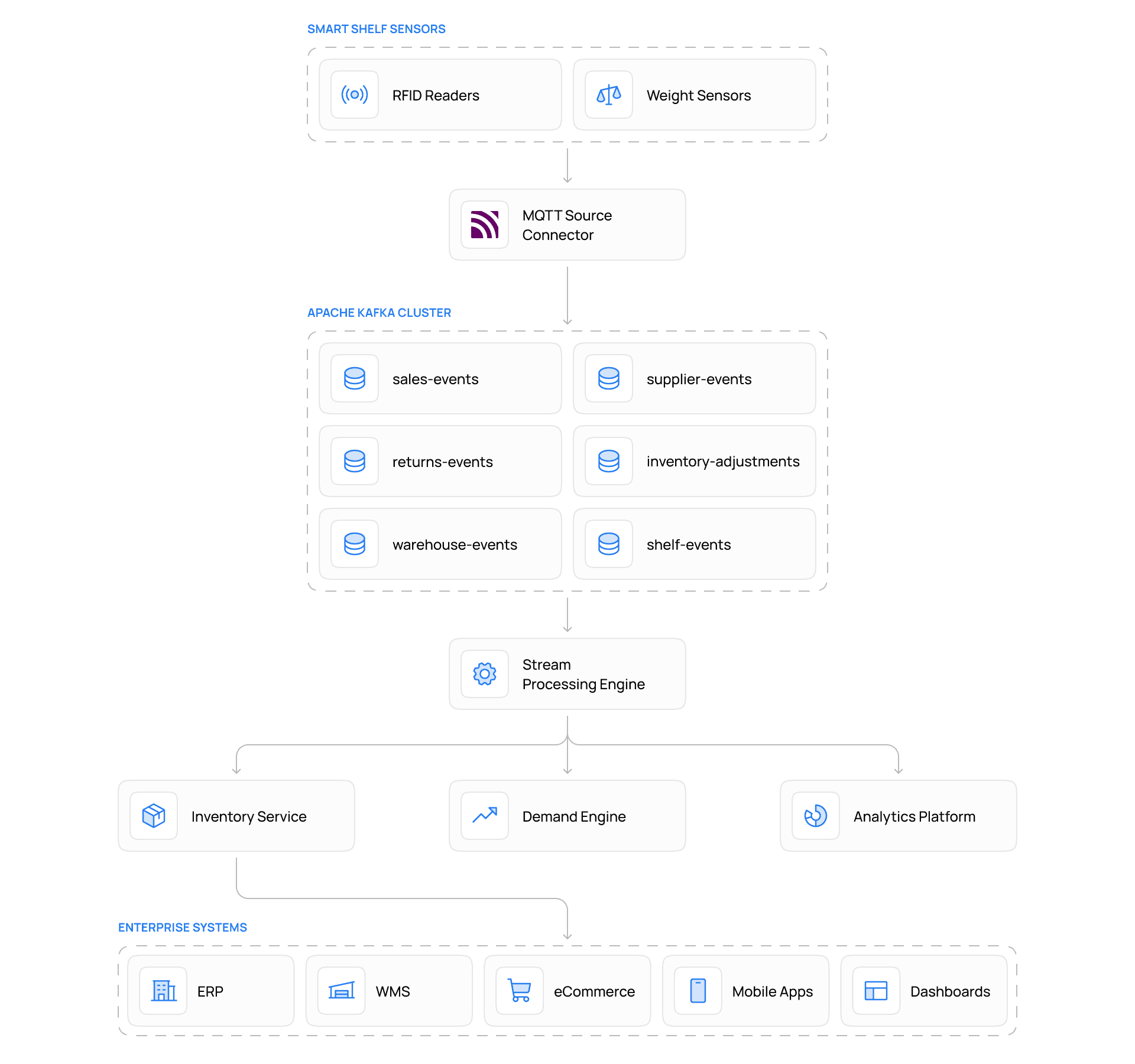
Every system publishes only the events it owns. A POS system publishes completed sales, warehouse systems publish inventory movements, suppliers publish shipment updates, and smart shelf sensors report physical inventory changes. Kafka distributes these events to every downstream consumer, allowing each application to process the same inventory stream independently.
This architecture eliminates point-to-point integrations and provides a single event backbone for inventory operations.
Using MQTT for Real-Time Shelf Monitoring
While transactional systems capture sales and warehouse operations, they often don't detect what happens on the store floor before a transaction occurs.
For example:
A customer removes an item from a shelf.
A store associate replenishes inventory.
Products are moved to a different display.
Items are misplaced or damaged.
Shelf inventory reaches a critical threshold.
These events are invisible to traditional inventory systems until a manual inventory count or a sales transaction updates the database.
Smart shelves equipped with RFID readers, weight sensors, barcode scanners, or computer vision systems can continuously publish these changes using MQTT. An MQTT source connector ingests these events into Kafka, making them immediately available to inventory services, ERP platforms, monitoring dashboards, and analytics applications.
If you're building IoT-driven streaming applications, our guide on IIoT Data Source Connector: Enabling Real-Time Data Ingestion and Transformation explores this integration in greater detail.
For organizations building IoT-enabled retail solutions, MQTT connectors simplify the ingestion of real-time device data into streaming pipelines. Learn more about integrating industrial and IoT data sources in our guide to the IIoT Data Source Connector Enabling Real-Time Data Ingestion and Transformation.
Simplifying Retail Inventory Pipelines with Condense
Building the architecture above involves more than deploying an Apache Kafka cluster. Engineering teams must integrate data from retail applications, ingest IoT events, process inventory streams, monitor pipeline health, and ensure the platform scales reliably as transaction volumes grow.
Condense simplifies these operational challenges by providing a unified platform for building and managing real-time streaming applications. With fully managed Kafka, enterprise connectors, visual pipeline development, and built-in stream processing, teams can develop production-ready inventory pipelines without managing the underlying streaming infrastructure.
For retail inventory workloads, Condense enables teams to:
Ingest events from POS systems, ERP platforms, warehouses, suppliers, databases, and MQTT-enabled devices.
Design and deploy inventory pipelines through a visual interface or code-based workflows.
Process inventory events using built-in transformations and stream processing capabilities.
Monitor pipeline health, throughput, and consumer performance from a centralized dashboard.
Deploy securely within their own cloud environment using a Bring Your Own Cloud (BYOC) model.
By abstracting much of the operational complexity, Condense allows engineering teams to focus on building inventory applications instead of maintaining the streaming platform that powers them.
Detecting Stockouts and Predicting Demand
Real-time inventory management isn't just about knowing how many products are available. The real value comes from continuously analyzing inventory events to detect potential stockouts, automate replenishment, and respond to changing customer demand before it impacts sales.
With Apache Kafka acting as the event backbone, retailers can correlate events from multiple systems as they occur, creating a live inventory view that reflects the current state of every product across stores, warehouses, and fulfillment centers.
Correlating Inventory Events in Real Time
A stockout rarely occurs because inventory suddenly reaches zero. More often, it happens because different systems have different views of inventory.
Consider a common retail scenario:
A customer purchases the last two units of a product in a store.
The POS system immediately records the sale.
A warehouse has already dispatched replacement inventory.
The shipment is still in transit.
The ERP continues to show inventory as available because the latest warehouse update hasn't been processed.
Without a shared event stream, each system operates independently, making it difficult to determine the true inventory position.
By streaming these events through Apache Kafka, retailers can correlate sales, warehouse movements, supplier deliveries, and inventory updates as they occur. Instead of waiting for scheduled synchronization, every new event contributes to a continuously updated inventory state.
Event Source | Event | Inventory Impact |
|---|---|---|
POS | Product sold | Reduce available inventory |
Warehouse | Shipment dispatched | Inventory replenishment in transit |
Store Receiving | Shipment received | Increase available inventory |
Supplier | Delivery confirmed | Update inbound inventory |
Shelf Sensor | Shelf empty | Confirm physical stock depletion |
This continuous event processing enables inventory services to maintain an accurate inventory position while ensuring every downstream application works with the same information.
Real-Time Stock Tracking Across Retail Channels
Modern inventory exists in multiple locations simultaneously. The same product may be available in a retail store, regional warehouse, fulfillment center, or online marketplace.
As inventory moves between these locations, every change needs to be reflected across all customer-facing and operational systems.
With an event-driven architecture, each inventory movement is published once and consumed by multiple applications independently. This enables:
Consistent inventory visibility across physical and online channels.
Faster inventory updates for ERP, WMS, and eCommerce platforms.
Improved order allocation and fulfillment decisions.
Reduced risk of overselling.
Better inventory accuracy across the retail network.
Instead of synchronizing databases throughout the day, retailers continuously update inventory as business events occur.
Using Streaming Data for Demand Sensing
Traditional forecasting models primarily rely on historical sales reports. While useful for long-term planning, they often fail to capture sudden changes in customer demand caused by promotions, seasonal events, regional trends, or unexpected buying patterns.
Streaming data provides a more dynamic approach.
As inventory events flow through Kafka, retailers can continuously evaluate metrics such as:
Current sales velocity
Inventory depletion rate
Product return patterns
Warehouse replenishment frequency
Supplier lead times
Regional demand trends
Rather than generating reports at the end of the day, these metrics are updated continuously, giving supply chain teams a real-time view of changing demand.
This allows retailers to identify fast-moving products earlier, prioritize replenishment, and make inventory decisions based on current business activity instead of historical snapshots.
Enabling Automated Restocking
Once inventory events are available as a continuous stream, retailers can automate replenishment based on predefined business rules.
For example, a stream processing application can evaluate conditions such as:
Shelf inventory falls below the minimum threshold.
Sales velocity exceeds the expected rate.
Replacement inventory is available in a nearby warehouse.
Supplier lead times remain within acceptable limits.
When these conditions are met, the application can automatically generate a restocking recommendation or notify store operations before customers encounter empty shelves.
By combining real-time stock tracking with continuous event processing, retailers shift from reacting to stockouts after they occur to preventing them altogether. This improves product availability, reduces lost sales, and enables more responsive inventory operations across the retail network.
Best Practices for Building Real-Time Inventory Management Pipelines
Building a real-time inventory management platform requires more than deploying Apache Kafka. Retailers need to ensure inventory events are accurate, ordered, scalable, and resilient as transaction volumes grow across stores, warehouses, suppliers, and online channels.
The following best practices help engineering teams build reliable inventory streaming applications while maintaining inventory consistency across the business.
Design Events Around Business Activities
Instead of publishing periodic inventory snapshots, publish business events that represent changes to inventory.
Examples include:
Product Sold
Inventory Reserved
Inventory Released
Goods Received
Warehouse Transfer Completed
Customer Return Processed
Inventory Adjusted
An event-driven model preserves the complete history of inventory changes, making it easier to replay events, audit inventory movement, and recover application state when needed.
Organize Topics for Scalability
Create dedicated Kafka topics for different inventory event types instead of combining unrelated events into a single stream.
A common topic strategy includes:
sales-eventsreturns-eventswarehouse-eventssupplier-eventsinventory-adjustmentsshelf-events
This separation simplifies event processing, improves scalability, and allows individual consumers to subscribe only to the events they require.
Preserve Event Ordering
Inventory updates for the same product should always be processed in sequence.
Partitioning topics using business identifiers such as SKU ID, Store ID, or Warehouse ID helps maintain event ordering while allowing the platform to scale horizontally.
Proper partitioning reduces the risk of inventory inconsistencies caused by out-of-order processing.
Monitor Streaming Pipelines Continuously
Operational visibility is essential for maintaining a healthy streaming platform.
Engineering teams should continuously monitor:
Consumer lag
Processing latency
Event throughput
Failed messages
Topic storage utilization
Consumer availability
Monitoring these metrics helps identify bottlenecks before they impact inventory accuracy or downstream applications.
Secure and Validate Inventory Events
Because inventory data directly influences purchasing, fulfillment, and replenishment decisions, every event should be validated before it updates inventory state.
Production deployments should also implement encryption, role-based access control, and schema validation to ensure inventory data remains secure and consistent across all connected systems.
Implementation Checklist
Before deploying a real-time inventory management platform, verify the following:
Area | Recommendation |
|---|---|
Event Design | Publish business events instead of inventory snapshots. |
Topic Strategy | Use dedicated topics for sales, returns, warehouse, supplier, and inventory events. |
Partitioning | Partition by SKU, Store ID, or Warehouse ID to preserve event ordering. |
Schema Management | Use versioned schemas to support application evolution. |
Consumer Scaling | Scale consumer groups independently based on workload. |
Monitoring | Track consumer lag, throughput, processing latency, and failed events. |
Security | Encrypt data in transit and implement role-based access control. |
Resilience | Configure replication, retries, and disaster recovery for high availability. |
Following these practices helps retailers build scalable inventory streaming pipelines that maintain accurate inventory visibility while supporting millions of inventory events across distributed retail operations.
Building Real-Time Inventory Applications with Condense
Apache Kafka provides the event streaming foundation for real-time inventory management, but building a production application requires more than moving events between systems. Inventory events need to be transformed, enriched with business context, validated, routed to downstream applications, and monitored throughout their lifecycle.
Condense extends Apache Kafka with a unified application platform that enables engineering teams to build, deploy, and operate these event-driven applications without assembling multiple development and operational tools.
For a retail inventory use case, a typical application built on Condense can:
Enrich POS events with product and store metadata before updating inventory.
Correlate sales, warehouse, supplier, and shelf events to maintain a real-time inventory state.
Trigger restocking workflows when inventory falls below predefined thresholds.
Route inventory updates to ERP, WMS, eCommerce platforms, analytics systems, and operational dashboards from a single processing pipeline.
Monitor application performance, processing latency, and event flow throughout the pipeline.
By combining application development, stream processing, deployment, and operations in a single platform, Condense enables teams to focus on delivering business logic instead of integrating and maintaining multiple components across the streaming stack.
Conclusion
Modern retail depends on accurate and timely inventory information. As businesses expand across physical stores, eCommerce platforms, warehouses, and supplier networks, scheduled inventory synchronization can no longer keep pace with the volume and speed of inventory changes.
By adopting real-time inventory management with Apache Kafka, retailers can process inventory events as they occur, maintaining a consistent view of stock across every operational system. This event-driven approach supports real-time stock tracking, faster replenishment, proactive stockout detection, and demand sensing, enabling retailers to respond quickly to changing customer demand.
Building these applications requires more than a messaging platform. Teams need the ability to develop, deploy, operate, and scale event-driven applications that transform inventory events into business outcomes. Condense simplifies this process by providing a unified platform for building production-ready streaming applications on Apache Kafka, enabling retailers to accelerate development while maintaining the flexibility and scalability of an event-driven architecture.