
TL;DR
Real-time systems rarely fail because of a single bad decision. These failure patterns are the downstream consequence of the forces that make real-time architectures hard to maintain schema drift, observability gaps, and operational sprawl.
They fail in familiar ways, often after months or years of stable operation. What changes is not the intent of the architecture, but the accumulation of small decisions that interact under scale, load, and change.
Across industries and use cases, the same patterns appear repeatedly. They show up in mobility platforms, IoT deployments, financial systems, logistics pipelines, and digital applications. The tools differ, but the symptoms look remarkably similar.
When Pipelines Multiply Instead of Evolving
One of the earliest warning signs is the quiet multiplication of pipelines.
A live stream handles real-time events.
A separate pipeline is introduced for periodic aggregation.
Another pipeline supports alerts or compliance checks.
Yet another exists for backfills or reprocessing.
Each pipeline serves a legitimate purpose. Over time, however, they diverge in logic, timing, and operational behavior.
What was once a single flow becomes a set of loosely related workflows that process the same data in different ways. Changes must be replicated across pipelines. Inconsistencies appear. Teams begin to ask which pipeline represents the source of truth.
The system still works, but it no longer behaves as a single real-time system.
The Cost of Excessive Processing Hops
As systems expand, data often passes through more stages than originally intended.
An event is ingested, transformed, forwarded, enriched, filtered, joined, stored, retrieved, and delivered. Each step exists for a reason. Together, they create long execution paths.
The effect is subtle but significant.
Latency becomes uneven rather than slow.
Failures propagate in non-obvious ways.
Retries at one stage amplify load at another.
Debugging requires tracing across multiple services and logs.
At this point, performance issues are not caused by any single component being inefficient. They emerge from the interaction between many correct components arranged in depth.
Tightly Coupled Chains That Resist Change
Another common pattern is accidental coupling.
Processing steps that were originally independent become linked through shared assumptions about timing, schema, or ordering. A small change in one stage requires coordinated updates across several others.
Over time, teams become cautious. Changes take longer to roll out. Temporary workarounds become permanent. New logic is added alongside old logic instead of replacing it, simply to avoid breaking existing behavior.
The architecture becomes fragile not because it is poorly designed, but because it has become difficult to modify safely.
Fragmented Observability and Partial Truths
As execution spreads across multiple systems, observability does the same.
Metrics exist in one tool.
Logs live in another.
Tracing is incomplete or inconsistent.
State is visible only within individual components.
Schema mismatch failures are among the most common and hardest to detect a producer deploys a breaking schema change, and consumers silently begin dropping or misinterpreting events. When something goes wrong, no single view explains what happened end to end. Teams reconstruct behavior manually by correlating timestamps, offsets, and logs across systems.
This makes root cause analysis slow and uncertain. More importantly, it makes it hard to build confidence in the system’s behavior, even when it appears healthy.
Scaling That Behaves Correctly, Yet Feels Unpredictable
Real-time systems are designed to scale. Most of the time, they do.
The problem arises when different parts of the pipeline scale independently.
Ingestion keeps up with traffic.
Kafka absorbs bursts.
Processing lags temporarily.
Downstream systems apply backpressure.
Each layer responds as designed. Yet from a system perspective, behavior feels inconsistent. Latency spikes appear without obvious causes. Bottlenecks move over time. Capacity planning becomes guesswork.
The issue is not the absence of scaling, but the lack of alignment between scaling decisions.
Why These Patterns Keep Reappearing
These failure patterns are not tied to specific technologies or teams. They emerge because real-time systems are assembled from components that are optimized locally, not systemically. Most real-time architecture failures share a common root cause: insufficient observability that would have detected the anomaly before it escalated to a production outage.
Each component is correct in isolation.
Each decision makes sense at the time it is made.
The architecture evolves gradually, not abruptly.
By the time the patterns are visible, they are deeply embedded in how the system operates.
This is why similar architectures exhibit similar problems, regardless of cloud provider, programming language, or streaming framework.
How Condense Breaks the Pattern Cycle
Condense addresses these failure patterns by reducing the number of independent execution surfaces involved in real-time processing. Many failure patterns trace back to operational complexity teams managing too many moving parts manually, leaving insufficient time for monitoring and proactive maintenance.'
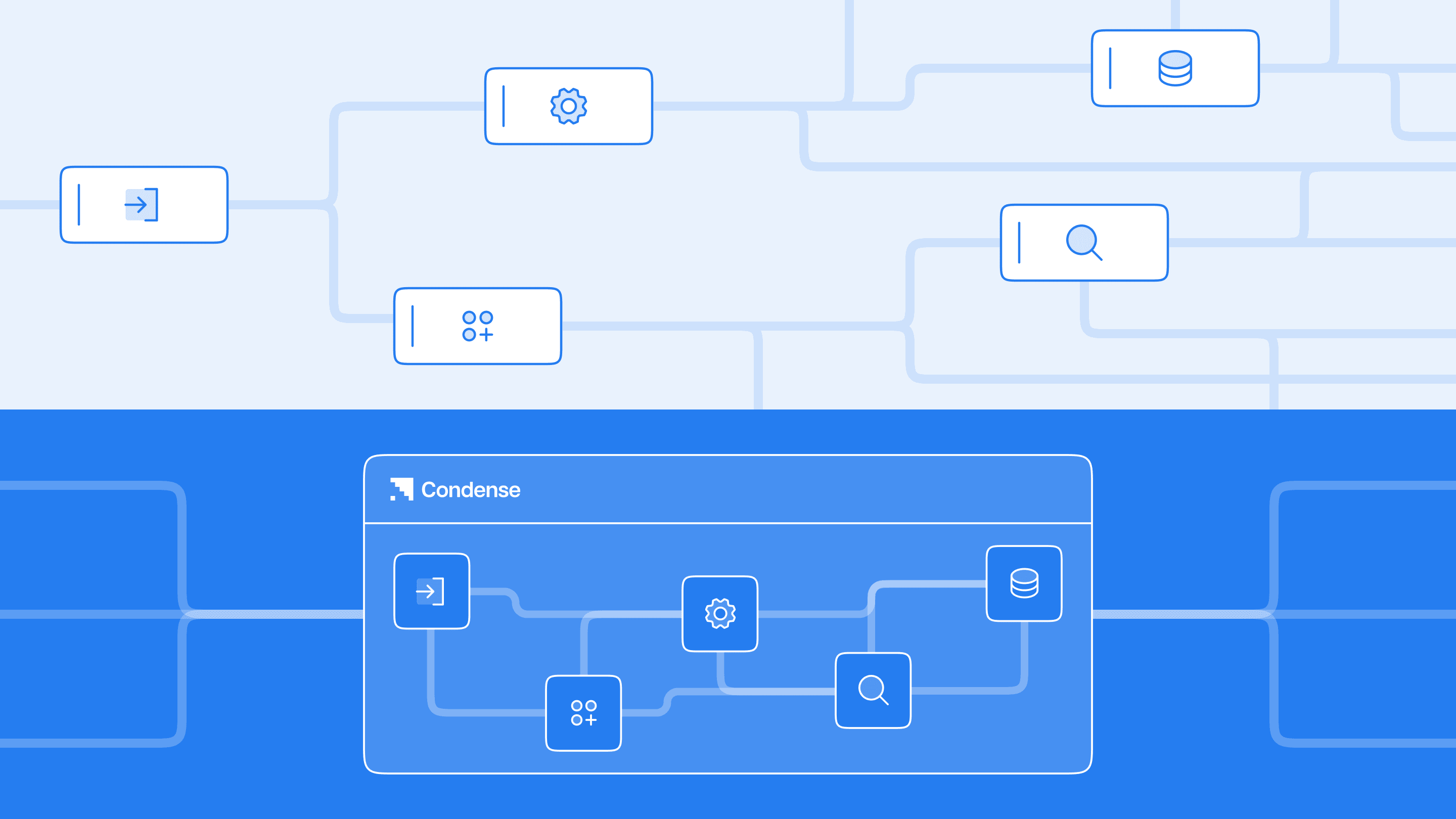
Instead of spreading ingestion, transformation, routing, state, and delivery across multiple systems, Condense brings them into a single Kafka-native execution environment that runs inside the customer’s cloud.
This changes how failure patterns manifest.
Pipelines evolve within one platform rather than multiplying externally.
Processing depth is reduced because logic runs closer together.
Coupling is easier to see and manage within a shared execution model.
Observability reflects the full lifecycle of events.
Scaling decisions are coordinated across stages.
The system becomes easier to change not because it is simpler in concept, but because it is simpler in structure.
Recognizing the Signals Early
The value of understanding these patterns is not only in fixing existing systems, but in recognizing the signals early.
When pipelines start to duplicate.
When hops begin to accumulate.
When changes require increasing coordination.
When observability becomes fragmented.
These are indicators that the architecture is drifting toward complexity, even if everything still appears functional. Condense provides a way to respond to these signals by consolidating execution before fragmentation becomes entrenched. The most effective way to reduce recurring failure patterns is modernizing the streaming stack replacing brittle DIY glue with a platform that handles failure recovery natively.
From Reactive Fixes to Structural Stability
Most teams address real-time failures reactively. They optimize individual services, add monitoring, or introduce new tooling.
Those actions help, but they do not change the structure that produces the failures.
Condense focuses on structural stability. By unifying real-time execution around Kafka within a single platform, it reduces the conditions that give rise to recurring failure patterns in the first place.
That shift is what allows real-time systems to scale in capability without scaling in fragility.