
TL;DR
Fleet intelligence platforms like this are the operational heart of connected mobility turning raw vehicle data into decisions that improve safety, efficiency, and uptime. On June 26, 2025, Zeliot and iTriangle delivered a live technical demonstration that turned a bold claim into a tangible system: building a complete, real-time vehicle control pipeline, inside the customer’s own cloud, in less than 40 minutes.
No mockups. No preloaded scripts. Just real data from a live iTriangle telematics device, a Git-backed geofence transform, Kafka topics running in BYOC (Bring Your Own Cloud) mode, and output to PostgreSQL and a connected FMS system.
Watch the Full Webinar Here: Webinar Recording
What the Webinar Demonstrated
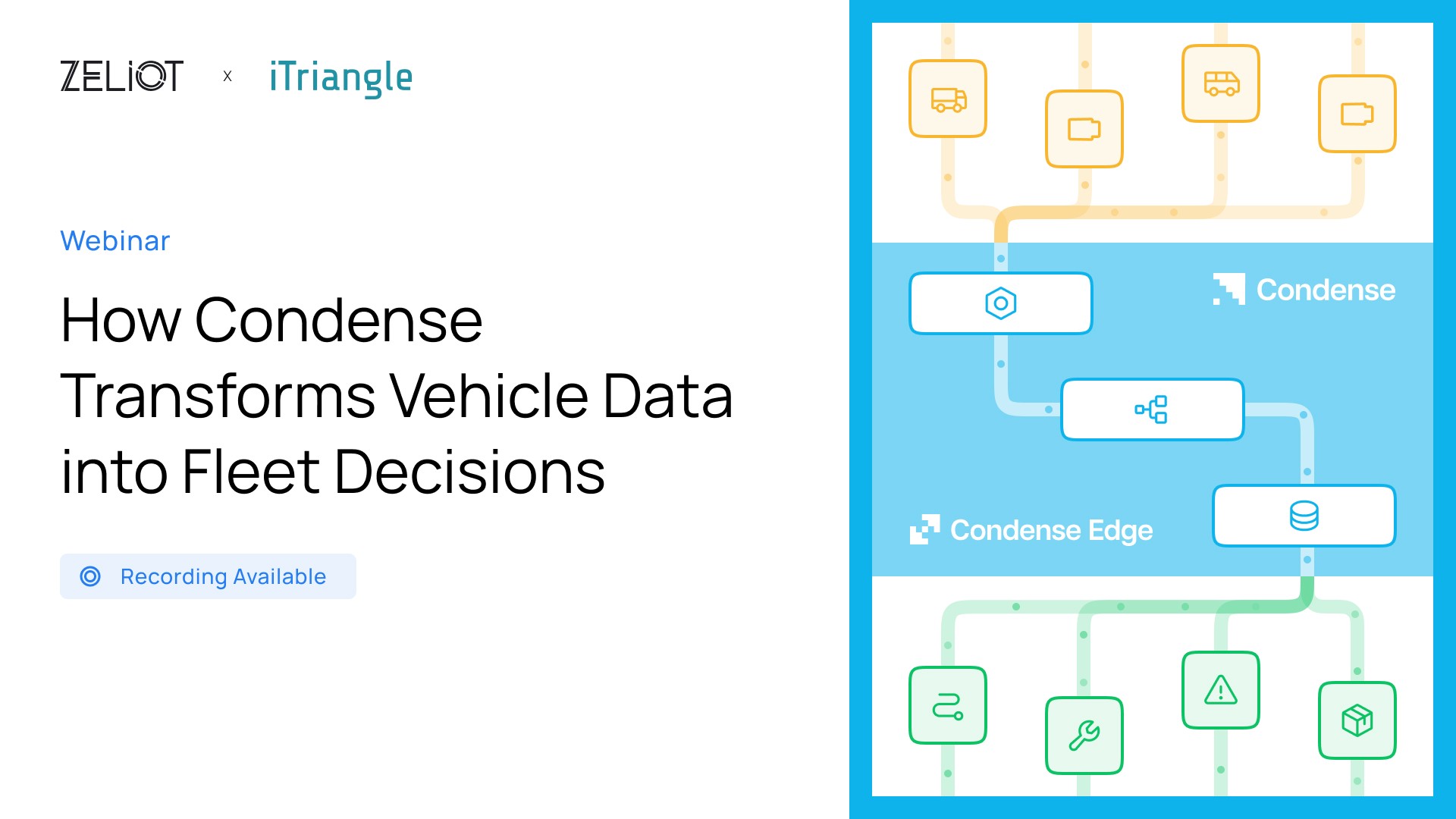
Vehicle telemetry from iTriangle devices is transmitted via MQTT and ingested into Kafka topics where Condense processes events in real time. This wasn’t a theoretical pitch. The live demo walked through the complete lifecycle of a real-time geofence control system:
Live Ingestion from an iTriangle's TS-101 Plus 4G device installed in a demo vehicle
Periodic Parsing via prebuilt Condense transform to generate continuous telemetry
Geofence Logic deployed from Git using Condense’s custom logic framework
Alert Routing to PostgreSQL and Kafka-connected FMS tools
BYOC Kafka setup on AWS with zero-touch DevOps
End-to-End Observability through Condense unified UI (logs, metrics, traces)
All configured live by Zeliot’s team in front of a technical audience, without relying on any auxiliary cloud orchestration or manual infrastructure setup.
A Keynote That Set the Context
Before diving into the technical build, the session featured a keynote by Vadiraj Katti, Managing Director at iTriangle. His remarks contextualized the collaboration between iTriangle and Zeliot, emphasizing their joint focus on scalable telematics, clean data, and cost-optimized real-time mobility applications.
Vadiraj outlined iTriangle’s journey in building holistic telematics devices with a footprint of over 2.5 million installations across India, Middle East, and Southeast Asia. He highlighted their sector-specific product lines, from OBD and ADAS to EV compliance and OEM-centric edge solutions.
Key innovations discussed included:
Vehicle Firmware Upgrade Over-the-Air (Aquila Edge): Letting OEMs remotely flash and debug ECU modules.
Edge-Level Computation: Deriving critical operational parameters (speed, trip distance, coolant temp, ignition status, etc.) in-device to reduce cloud dependency.
Vertical Focus: Supporting mining, logistics, passenger transport, and fleet management, all through tailored data points and compliance support.
The keynote closed by reinforcing how the iTriangle <> Zeliot partnership delivers not just telemetry, but actionable value: cleaner data pipelines, enhanced observability, and faster go-to-market solutions for fleet intelligence. Beyond fleet decisions, the same real-time streaming architecture enables predictive maintenance detecting vehicle anomalies before they become failures
Technical Breakdown of the Live Build
Here’s how the real-time control system was built live:
1. Kafka + BYOC Foundation
All infrastructure ran inside a customer-owned AWS account via Condense BYOC deployment. Kafka topics, Postgres database, and Git-integrated transforms were fully instantiated in the demo cloud. This ensured:
Data sovereignty
Zero vendor lock-in
Transparent cloud billing
Alignment with enterprise IAM policies
2. Real Device, Real Data
An iTriangle TS-101 device in a demo vehicle streamed TCP location data at high frequency. Condense protocol-aware prebuilt connector decoded this in real time, exposing structured payloads (latitude, longitude, speed, ignition, etc.) without manual parsing.
3. Prebuilt Periodic Transform
Condense low-code periodic transform created structured, heartbeat-style messages at consistent intervals. These acted as input for downstream applications, simplifying geofence state monitoring.
4. Git-Based Geofence Logic
A custom geofence application, written in Python and versioned in Git, was deployed live using Condense transform builder:
Input: GPS location from periodic output
Logic: Geo-boundary check using configured polygon radius
Output: Alert payload to PostgreSQL and Kafka for FMS visibility
This containerized transform was CI/CD-ready, rollback-safe, and updated without restarting Kafka pipelines.
5. PostgreSQL + FMS Integration
Two output sinks were configured:
A Kafka-to-Postgres connector with schema control and retention policies
A Kafka-forwarder that pushed alerts to a connected Fleet Management System dashboard
Together, they enabled historical storage for analysis and real-time visibility for operations.
What Makes This Important
This webinar didn’t just show a working demo; it modeled a fundamentally better way to build real-time systems:
Capability | Traditional Kafka Stack | Condense |
|---|---|---|
Device Protocol Integration | Manual or 3rd-party | Built-in Connectors |
Real-Time Transform Logic | DIY Apps or Flink Jobs | GitOps + UI-native |
BYOC Kafka Deployment | Complex, Partially Supported | Fully Native |
Full Observability | Requires Prometheus, Grafana | Built-In |
Business Logic as Code | External CI/CD | Git-Connected, UI-Deployable |
Use-Case Awareness | General Purpose | Mobility-Tuned (e.g., Geofence, Panic, Immobilizer) |
Final Takeaway
By the end of this session, a fully operational geofence alerting system was running live, in a customer’s cloud, from raw GPS data to actionable FMS alerts.
There was no simulation. No code editing during the demo. No dependency on SREs. Just a clear example of what’s possible when:
A domain-specific Kafka platform (Condense)
Meets hardware-aware device providers (iTriangle)
And skips the glue code chaos that burdens most real-time stacks.
Condense powers this fleet intelligence platform at a flat monthly cost no per-connector fees, no schema registry surcharges.
🔗 Watch the Full Webinar: Webinar Recording
If your teams are working on real-time mobility, geofence compliance, or vehicle intelligence systems, this session is worth watching, not just for the product, but for how it redefines execution.
To see this kind of vehicle intelligence pipeline built live, watch our 30-minute demo of a real-time vehicle data pipeline built end-to-end with Condense. Let us know if you’d like a personalized walkthrough or want to replicate a similar system in your cloud.